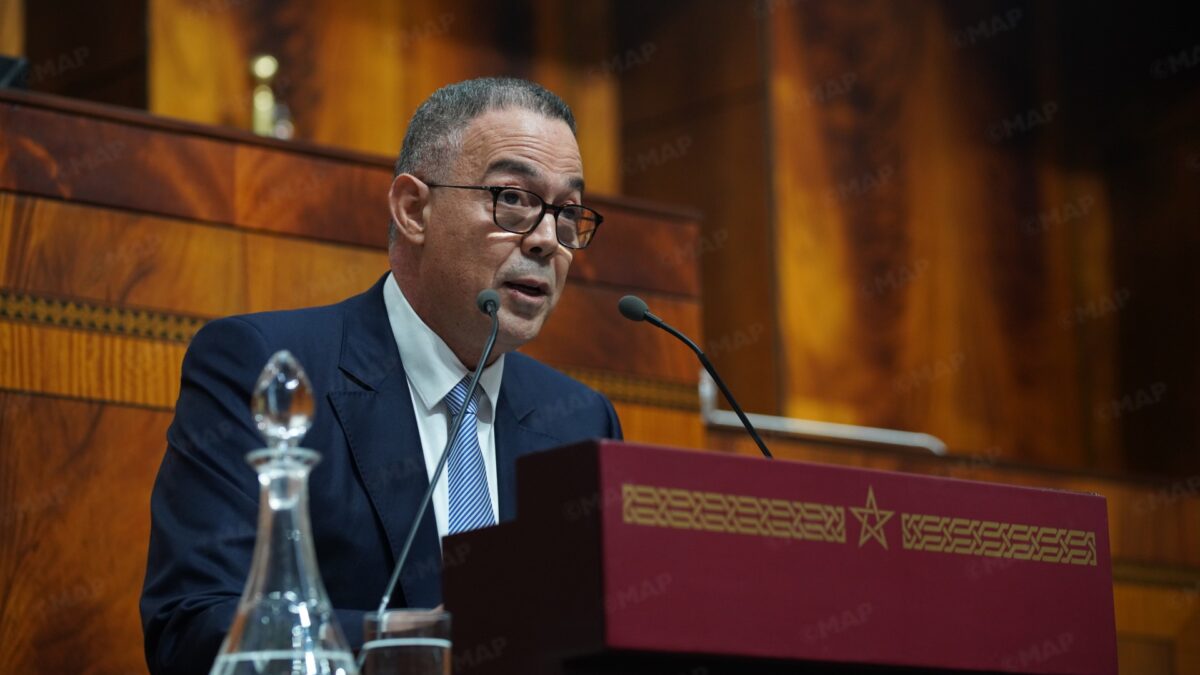
Rabat – The 2027 Finance Bill aims to balance the mobilization of available resources to accelerate the achievement of the government’s commitments with the consolidation of the financial and economic margins necessary for their sustainability, within an international context that calls for vigilance and a judicious ranking of priorities, stated the Minister of Economy, Finance and Public Performance, Fouzi Lekjaa, on Friday.
During the presentation of the 2027 Finance Bill at a joint plenary session in the House of Representatives, Lekjaa emphasized that “global shifts and the resulting risks make it imperative to strengthen the resilience of the national economy and preserve sovereign decision-making margins.”
He added that this requires “stimulating productive investment, strengthening state resources, and directing spending toward priorities with high economic and social impact.”
In this context, Lekjaa noted that preserving the balance of state finances is an essential condition for continuing reforms and ensuring the long-term protection of social rights. The solidity of public finances, he argued, “makes it possible to meet commitments, face crises with strength, and have a clear vision to pursue development projects.”
“It is our responsibility to ensure that every dirham of public money is allocated to a clearly defined purpose and produces a tangible impact, and to make the efficiency of public spending and the accountability of officials fundamental principles in the exercise of political responsibility,” he said.
Lekjaa also pointed out that the Finance Bill was drafted in an international context marked by persistent uncertainties, as global economic growth is expected to see a slight recovery to reach 3.4% in 2027, compared to 3.1% in 2026. Growth in the eurozone, the Kingdom’s main trading partner, is expected to remain moderate at 1.1% in 2026 and 1.2% in 2027, which makes it necessary to continue diversifying foreign markets and the growth sources of the national economy, he added.
Faced with these shifts, the Minister affirmed that Morocco is capitalizing on the achievements of the reforms and projects initiated under the enlightened leadership of His Majesty King Mohammed VI, with a view to strengthening its resilience and taking advantage of the opportunities offered by the reconfiguration of the global economy.
At the national level, the project was developed in a context where economic growth is expected to reach 4.7% in 2026, he said. This estimate is based on a 2.9% increase in non-agricultural activities and an 18% rebound in agricultural activity, within a context marked by a cereal harvest of 90 million quintals for the 2025-2026 agricultural season.
This dynamic, according to Lekjaa, should be accompanied by controlled inflation of around 0.7%, while foreign exchange reserves should cover nearly six months of imports by the end of the year.
Regarding public finances, the Minister noted that the budget deficit should be reduced to 3% of the gross domestic product (GDP) in 2026, representing a half-point improvement compared to 2025, while the debt ratio should stabilize at 67.5% of GDP.
He explained that this trajectory is supported by “the strong performance of tax revenues, which reached 288.3 billion dirhams (MAD) by the end of September 2026, an increase of MAD 30.2 billion, or 11.7% compared to the same period of the previous year.”
These figures provide the Kingdom with a foundation to pursue reforms and finance its priorities, while confirming the need to strengthen non-agricultural growth, consolidate the country’s sustainable resources, and preserve the balances that guarantee its intervention capacity, the Minister noted.
In this wake, Lekjaa emphasized that building a social state based on social justice requires an integrated approach that reconciles the economic and social dimensions, believing that such a model cannot rely on an economic policy that opposes social imperatives and favors logics of monopoly and exclusion.
Thus, he noted that while the state must create conditions conducive to productive investment and private initiative, which generate wealth, it is also its responsibility to protect citizens’ rights to a dignified life and to ensure that the market does not become an unregulated space at the expense of the poorest populations and families’ purchasing power.
Only under this condition can we speak of a social state, the Minister maintained, specifying that this refers to a state that is not limited to providing medical coverage and direct aid, but also intervenes to fight corruption and conflicts of interest, guarantee food and energy security, and combat monopolies in order to open up development prospects for small and medium-sized enterprises.
This approach should create a framework conducive to respecting the rights and obligations of different segments of society, in accordance with the provisions of the Kingdom’s Constitution, he added.
Lekjaa pointed out that achieving these goals depends on implementing an economic policy aimed at creating the necessary conditions for the emergence of a new Morocco. This requires, above all, strengthening the rule of law, both legislatively and executively, in order to guarantee transparency and the legal protection of free enterprise, particularly for very small, small, and medium-sized enterprises.
In this perspective, the Minister called for an in-depth and responsible parliamentary debate on the choices made in this bill, capable of enriching its content and strengthening its impact, while respecting the competencies of each institution and the constitutional role of the opposition, in accordance with the provisions of the Constitution, all with a view toward preserving the balance of public finances.
Related articles
Lower House Adopts Government Program by Absolute Majority
Rabat – The House of Representatives adopted by an absolute majority, on Thursday during a plenary session, the…
Laayoune Prepares to Mark Inaugural Unity Day Ahead of Green March Anniversary
Laayoune is gearing up to observe Morocco’s newly created Unity Day on October 31, followed by the 51st…
Morocco Delivers Military Vehicles and Supplies to Liberia to Support Special Forces Training
A Moroccan C-130 military cargo aircraft landed on Monday at Roberts International Airport in Liberia, carrying a shipment…