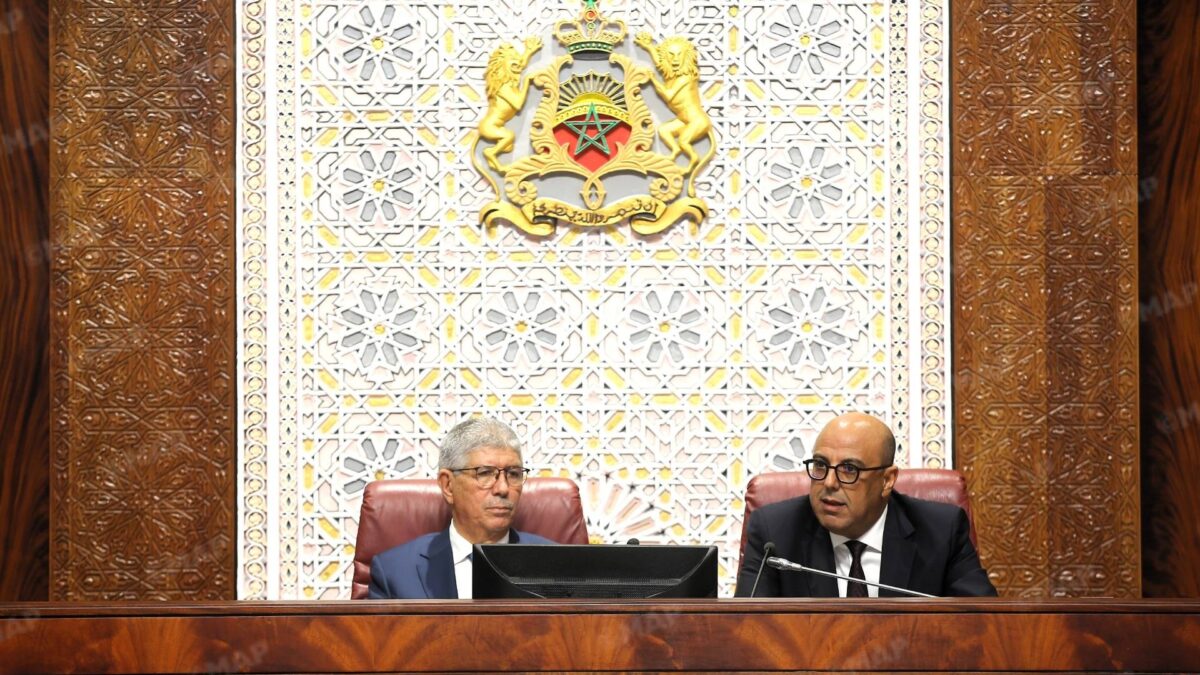
Rabat – The international community has not opted for inaction, but has instead moved towards recognizing the realism and credibility of the Kingdom of Morocco’s position and the initiatives it has put forward to put an end to decades of waiting and prolongation of the conflict over the Moroccan Sahara, Upper House Speaker Mohamed Ould Errachid said on Monday in Rabat.
Speaking at a joint session of the two Houses of Parliament devoted to the latest developments regarding the national cause, Ould Errachid highly praised the achievements of the Wise Royal Diplomacy, pursued with great perseverance by His Majesty King Mohammed VI, a diplomacy that, he said, knows when to speak, when to listen and when to let time reveal the truth.
On this occasion, he expressed his sincere thanks and deep appreciation to “our brothers and friends around the world, as well as the various states, governments, parliaments, parliamentary unions and institutions that have expressed their support for Morocco and its national cause”, considering that these positions “reaffirm confidence in the seriousness and credibility of the autonomy initiative under Moroccan sovereignty.”
This joint session of the two Houses of Parliament is being held at a “pivotal moment in the history of our foremost national cause; a moment when we must bear in mind, above all, that behind diplomatic positions and international resolutions lie the cause of a homeland, the memory of a people, the sacrifices of several generations and the will of a nation that cannot compromise on its territorial integrity”, he said.
In this regard, he expressed his deep pride and high appreciation for the content of the Royal Office statement, which reflects great clarity of vision and genuine foresight, and marks a shift from an approach based merely on managing the dispute to one founded on a profound transformation of its parameters.
The wise leadership of His Majesty King Mohammed VI constitutes the fundamental pillar that has guided this process and enabled the national cause to achieve significant qualitative political and diplomatic gains, Ould Errachid said.
After recalling the collective position expressed by the European Union, as well as the growing support for the Kingdom’s position from new countries around the world, the Speaker of the House of Councillors stressed that “this momentum was further strengthened on October 30, when eleven members of the United Nations Security Council supported a draft resolution aimed at reviewing the mandate of the UN mission and establishing the autonomy initiative under Moroccan sovereignty as the sole basis for negotiations and a definitive solution.”
For Ould Errachid, one of the main foundations of the Kingdom’s position lies in the combination of historical and democratic legitimacy, as embodied by the effective presence of Moroccans originating from the Moroccan Sahara at the heart of the Kingdom’s constitutional institutions and at various levels of public affairs management. He explained that this historical legitimacy is rooted in the ties of allegiance and loyalty that united the Sahrawi tribes and their sheikhs with the Glorious Alaouite Sultans and Kings.
These ties have been consolidated through democratic practice and electoral representation as part of an ongoing process of political participation, culminating in the legislative elections of September 23, during which the Southern Provinces recorded the highest voter turnout rates nationwide, thus illustrating their unwavering sense of national belonging and commitment to shaping their future within the framework of Morocco’s sovereignty and the Kingdom’s territorial integrity, he added.
“In light of these developments, our country is moving confidently towards the future, drawing on national consensus and the cohesion of the people around the nation’s fundamental principles, while remaining committed to peace and the ceasefire and determined to safeguard its sovereignty, territorial integrity and the security of its citizens,” he stressed.
In this context, Ould Errachid highlighted the responsibility of the parliamentary institution in supporting this momentum, which requires the nation’s representatives to step up and intensify their efforts on three fundamental fronts, notably by strengthening bilateral and multilateral parliamentary diplomacy and ensuring the continued commitment of both Houses of Parliament to supporting the efforts of official diplomacy in defending the national cause.
These efforts also involve Parliament’s ability to “keep pace with the various developments affecting the national cause, sustain national mobilization and strengthen our domestic front”, which has been a fundamental driving force throughout this process in “defending our territorial integrity as a unifying cause that transcends political and partisan divisions and brings together institutions and all the nation’s active forces”.
He also noted that the latest developments go far beyond the mere end of the mandate of a UN mission, pointing out that they could open up new prospects for a definitive settlement of the Moroccan Sahara issue, “which must put an end to the suffering of our brothers in the Tindouf camps”.
An entire generation has grown up in so-called temporary tents, and it is inconceivable that another generation should do the same, he maintained, stressing that “returning to the motherland is a defeat for no one, but rather a return home, to a place whose doors have always remained open, so that people can contribute to the continued development taking place in the Moroccan Sahara, within the framework of national sovereignty and the Kingdom’s territorial integrity.”
“What we are experiencing today invites us to remember, with all due reverence, the martyrs of territorial integrity, as well as the immense sacrifices made by our Royal Armed Forces, deployed along the country’s borders to defend its territorial integrity,” he stressed.
He also highlighted the “ongoing efforts made by the various military and security services, namely the Royal Gendarmerie, National Security, Auxiliary Forces, Civil Protection and local authorities, in fulfilling their national duty and safeguarding citizens’ security, under the wise leadership of His Majesty King Mohammed VI, May God Assist Him.”
Related articles
“Power Export” Program: 535 Applications Registered for Export Support (Minister)
Rabat – Some 535 applications have been registered under the “Power Export” program, designed to support Moroccan companies…
Positive Developments Surrounding UN Vote Reflect Two Decades of Morocco’s Diplomatic Efforts – French Jurist
Paris – The positive developments on the Moroccan Sahara issue following Friday’s UN vote come as no surprise…
Non-Renewal of Minurso’s Mandate Opens New Diplomatic Phase Marked by Consolidation of Morocco’s Autonomy Plan- French Geopolitical Expert
Paris – The United Nations Security Council’s non-renewal of Minurso’s mandate opens a new phase in the process…