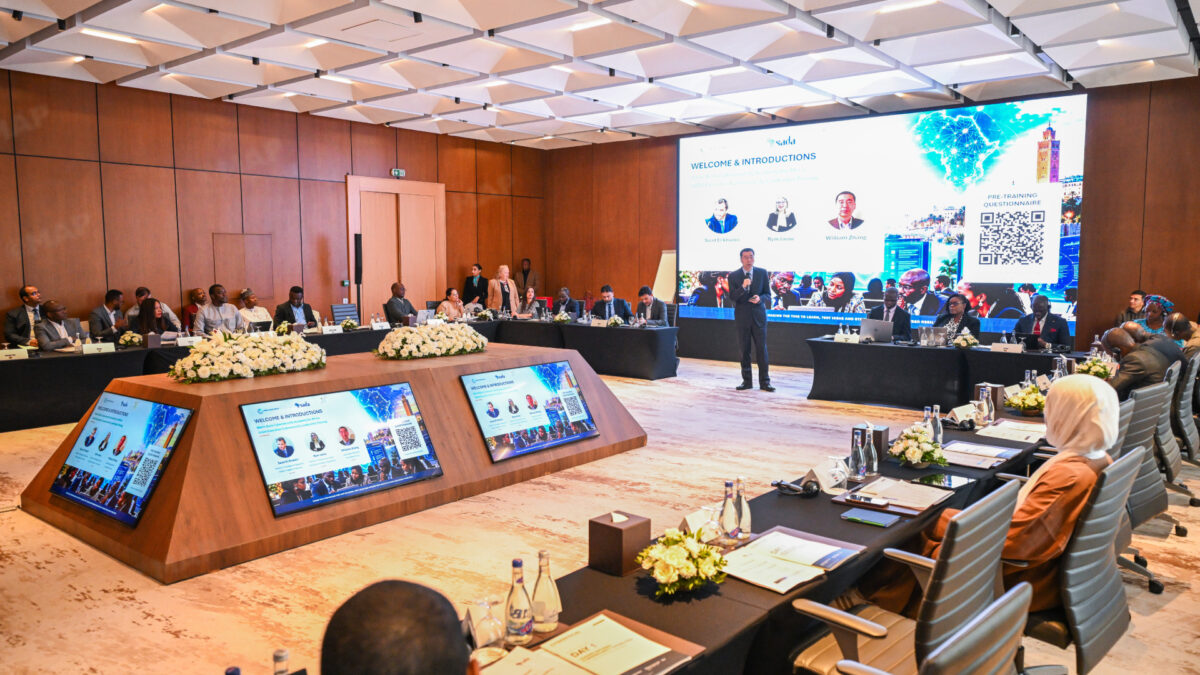
Rabat – The “Cyber Academy” executive cybersecurity training program, aimed at leaders and technical managers of cybersecurity authorities in African countries, opened on Monday in Rabat, with the goal of highlighting challenges related to decision-making and strategic leadership in this field.
Organized by the General Directorate of Information Systems Security (DGSSI) and the World Bank (WB), in partnership with the Smart Africa Digital Academy (SADA), this training program is part of efforts to build the capacity of African leaders in governance and cybersecurity.
It also aims to prepare for challenges related to AI and emerging cyber threats, while developing cyber crisis response mechanisms and strengthening cooperation and the exchange of expertise among African nations.
On this occasion, William Zhang, Lead Digital Transformation and Cybersecurity Expert at the World Bank, emphasized that this training is of paramount importance as it sits at the heart of global capacity-building in cybersecurity.
He added that its significance also lies in identifying the accelerating cyber risks brought on by AI, as well as the high level of preparation required by actors in the sector to address them.
In a statement to MAP, Zhang noted that many cybersecurity organizations face a resource shortage in meeting current challenges, warning that AI exacerbates this issue by making it easier to detect and exploit security vulnerabilities.
For her part, Rym Jarou, Director of Partnerships, Events, and Communication at the Smart Africa Digital Academy, stated that the training aims to enhance the capabilities of cybersecurity leaders and decision-makers so they can support the various facets of digital transformation across the African continent.
In a similar statement, Jarou stressed the importance of equipping leaders responsible for digital transformation in Africa with skills and capabilities related to cybersecurity management, not only at the operational level, but fundamentally at the strategic level.
In this regard, she recalled that the Smart Africa Digital Academy program focuses on training and capacity building in cybersecurity strategies, cyber operations, digital sovereignty, and data sovereignty in the wake of the evolving AI ecosystem.
For his part, Tawfiq Ali Lakssar, Head of the Cybersecurity Unit at the Yemeni Ministry of Telecommunications and Information Technology, insisted on the need to build an executive foundation for cybersecurity leaders, including how to lead cybersecurity units, in addition to developing plans to adopt and govern AI across all facilities, agencies, and training teams.
Lakssar remarked that the value of this executive training is reflected in its various programmed tracks, particularly regarding the creation of effective response plans aligned with international best practices, while seeking to leverage and exchange expertise with the various countries participating in the event.
Running through October 8 with the participation of several international and African cybersecurity experts, the training program features interactive sessions and cyber crisis simulations, enabling participants to examine key practical challenges in decision-making and strategic cybersecurity leadership.
Related articles

Taghazout Among the “10 Destinations to Discover Worldwide,” According to FlightHub
The seaside resort of Taghazout, located north of Agadir, is among the ten destinations highlighted by the Canadian…

Pink October: A Month and a Message That Can Save Lives
Every October, the world is bathed in pink; screens and building facades light up in this color, and…
Weather Forecast for Tuesday, October 6, 2026
Rabat – Here is the weather forecast issued by the General Directorate of Meteorology for Tuesday, October 6,…