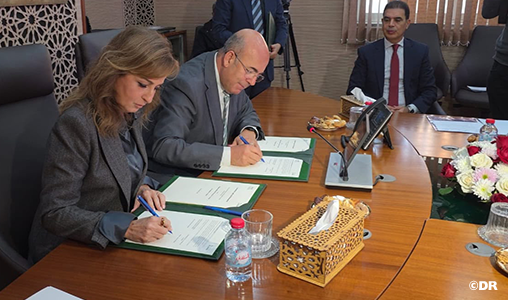
Rabat – Al Mada Foundation and the National Agency for Water and Forests (ANEF) signed a partnership agreement on Monday in Rabat for an ambitious program to plant and regenerate 1,000 hectares of argan trees in the Souss-Massa region.
Al Mada Foundation and the National Agency for Water and Forests (ANEF) signed a partnership agreement on Monday in Rabat for an ambitious program to plant and regenerate 1,000 hectares of argan trees in the Souss-Massa region.
The agreement was signed by Al Mada Group President and CEO, Noufissa Kessar, and Director General of the National Agency for Water and Forests, Abderrahim Houmy.
Fully funded by Al Mada Foundation, the program combines the preservation of Morocco’s natural heritage, technological innovation and the sustainable development of rural communities. It is aligned with national priorities regarding the preservation of natural resources, the fight against desertification and adaptation to climate change, in line with the objectives of the “Forests of Morocco 2020-2030” strategy.
Through this initiative, Al Mada Foundation reaffirms its commitment to making a tangible contribution to safeguarding Morocco’s natural heritage by mobilizing its financial resources alongside ANEF’s technical expertise and local knowledge.
Preserving a natural and cultural heritage unique in the world
An endemic species of Morocco, the argan tree is one of the most emblematic symbols of the Kingdom’s natural and cultural heritage.
A true bulwark against desertification, it plays an essential role in soil protection, biodiversity conservation and maintaining the ecological balance of central-western Morocco.
The argan forest also represents an exceptional economic and social asset, having been at the heart of traditional know-how and income-generating activities for local communities, particularly rural women, for centuries.
This heritage enjoys significant international recognition. The argan forest has been designated a UNESCO Biosphere Reserve since 1998, while the traditional knowledge and practices associated with the argan tree have been included on UNESCO’s Representative List of the Intangible Cultural Heritage of Humanity since 2014.
Today, increasingly vulnerable to recurring droughts, the effects of climate change and increasing pressure on natural resources, this ecosystem requires strengthened collective action to ensure its regeneration and preservation for future generations.
Addressing the increasing vulnerability of the argan forest and the challenges facing the sector
Successive droughts, soil degradation and difficulties in natural regeneration are placing increasing pressure on Morocco’s argan forests. This vulnerability comes amid a decline in the sector’s international trade: argan oil exports fell from more than 1,500 tonnes in 2019 to approximately 526 tonnes in 2025 (forecast estimate), representing a decrease of around 65%. This trend is attributable to several factors and should not be interpreted as an equivalent decline in national production.
To help address these challenges in a sustainable manner, Al Mada Foundation has decided to fully fund a program to plant 1,000 hectares of argan trees, to be implemented in partnership with ANEF.
The program aims to help restore forest resources, strengthen the ecosystem’s resilience to climate change and safeguard, over the long term, the natural resources essential to the sustainability of the argan sector and the economic activities of rural communities.
Waterbox: an innovative solution, successfully tested by ANEF, to optimize planting and save water
One of the programme’s key innovations is the use of the Waterbox system, an environmentally friendly solution particularly suited to planting in arid regions and areas facing water stress.
Already successfully tested by the National Agency for Water and Forests as part of other reforestation projects, this technology has demonstrated its potential to improve the survival and development of young plants while significantly reducing their water requirements.
The system collects and makes use of rainwater, dew and moisture from condensation, while limiting water loss through evaporation. The collected water is then gradually released around the roots, encouraging root development and the growth of young argan trees.
These results, which remain dependent on local planting conditions, highlight the potential of this innovation to support
Related articles
Dakhla Global Summit: Health, an Investment and a Common Good (Final Declaration)
Dakhla – Participants at the second Dakhla Global Summit, held on November 20 and 21, called on Saturday,…
Errachidia: The CPDH includes 53 projects for socio-economic vocation
The Provincial Comité of Human Development (CPDH) of Errachidia approved, at the March 2019 reunion, 53 projects for…
ANSS: First Installments of the Exceptional Bonus Disbursed to Encourage Households Receiving Direct Social Assistance to Enter the Formal Labor Market
Rabat – The National Social Support Agency (ANSS) has announced the disbursement of the first installments of the…