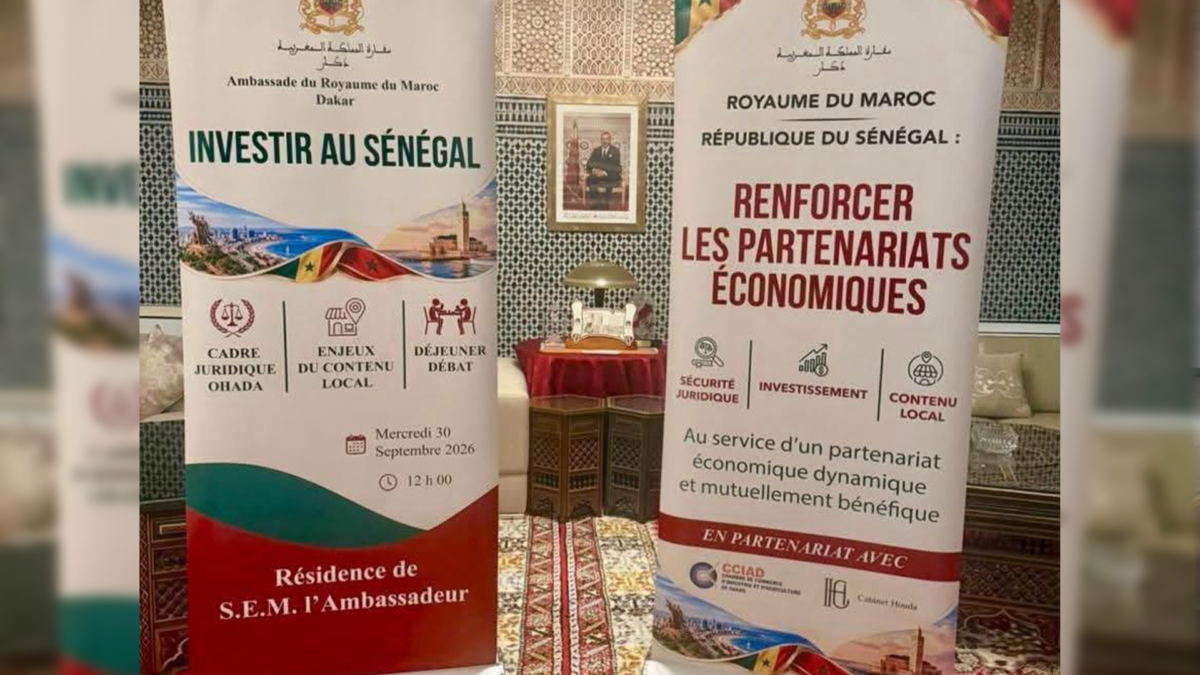
Legal Security and the Protection of Moroccan-Senegalese Investors on the Agenda of a Meeting in Dakar
Dakar – Issues related to legal security for business and the protection of Moroccan and Senegalese investors were the focus of a debate organized Wednesday in Dakar, at the initiative of the Embassy of the Kingdom of Morocco in Senegal.
Organized in partnership with the Dakar Chamber of Commerce, Industry and Agriculture (CCIAD) and a law firm, this meeting, themed “Investing in Senegal: OHADA Legal Framework (Organization for the Harmonization of Business Law in Africa) and the Challenges of Local Content,” provided an opportunity to discuss the business environment, investment conditions in Senegal, and ways to foster greater synergy between economic operators in the two countries.
Speaking at the event, the Moroccan Ambassador to Senegal, Hassan Naciri, emphasized that this meeting is part of the ongoing and deep-rooted relationship between the two countries. He noted that, under the leadership of His Majesty King Mohammed VI and Senegalese President Bassirou Diomaye Faye, the bilateral partnership is experiencing a period of growth in which investment, entrepreneurship, and value creation are playing an increasingly important role.
He recalled, in this regard, the holding of the 15th Joint High Commission on Cooperation and the Morocco-Senegal Economic Forum in Rabat and Casablanca on January 26 and 27, 2026, which reaffirmed the shared ambition to capitalize on the numerous existing opportunities.
For the Moroccan diplomat, the objective is to translate the close human and cultural ties, as well as the political will expressed at the highest level, into projects, investments, jobs, and value-creating partnerships. In this regard, he highlighted the importance of OHADA law in ensuring legal security for Moroccan companies wishing to invest, establish operations, or develop partnerships in Senegal, while emphasizing the need to understand its interaction with Senegalese national regulations and the regional legal framework.
Mr. Naciri also noted that local content should not be viewed solely as a requirement, particularly in the mining and hydrocarbon sectors, but also as a genuine opportunity to develop partnerships with Senegalese companies, promote the transfer of skills and expertise, and create greater value in Senegal.
This approach, he said, aligns with the concept of African cooperation shared by Morocco and Senegal, based on complementarity and integration.
For his part, the president of the Dakar Chamber of Commerce, Industry and Agriculture, Abdoulaye Sow, noted that Senegal and Morocco have considerable potential to deepen their partnerships, particularly in infrastructure, agriculture, industry, services, finance, new technologies, energy, and vocational training.
To transform this potential into sustainable results, it is essential to create conditions of trust, notably through stable regulations, legal security for transactions, transparent procedures, and the capacity of institutions to support investors, he stated, emphasizing the importance of the OHADA legal framework for investors operating in Senegal and, more broadly, within the community.
Mr. Sow also advocated for a shift from a focus on the presence of Moroccan companies in Senegal to one of co-investment, co-production, and the creation of regional value chains.
According to him, local content should be considered a driver of competitiveness and value creation, not an additional administrative burden, particularly by encouraging partnerships between Moroccan and Senegalese companies, local subcontracting, youth training, and skills transfer.
Discussions focused on the fundamental principles of OHADA law, legal certainty and investor protection, the principles and practices of local content in Senegal, as well as practical technical and legal case studies.
The meeting brought together Moroccan and Senegalese business operators, representatives of Senegalese institutions and government agencies, as well as experts and stakeholders from the business community.
Established by the Treaty of Port Louis (Mauritius) of October 17, 1993, OHADA, which currently has 17 member states, aims to harmonize business law in its member states through a common legal framework, designed in particular to strengthen the legal and judicial security of business activities.
Related articles
Morocco’s Experience in Crime Prevention Highlighted in Abu DhabiSeptember 29, 2026
Abu Dhabi – Morocco’s experience in evidence-based crime prevention was highlighted on Monday in Abu Dhabi during the…
Under HM the King’s Impetus, Morocco Places Water Security at Heart of National Priorities – Ambassador
Rome – Under the impetus of HM King Mohammed VI, Morocco has placed water security and climate adaptation…
Guinea-Bissau Reaffirms ‘Clear and Consistent’ Stance Backing Morocco’s Territorial Integrity and Sovereignty over its Sahara
United Nations (New York) – The Republic of Guinea-Bissau on Saturday, September 26, 2026, reaffirmed its “clear, consistent…