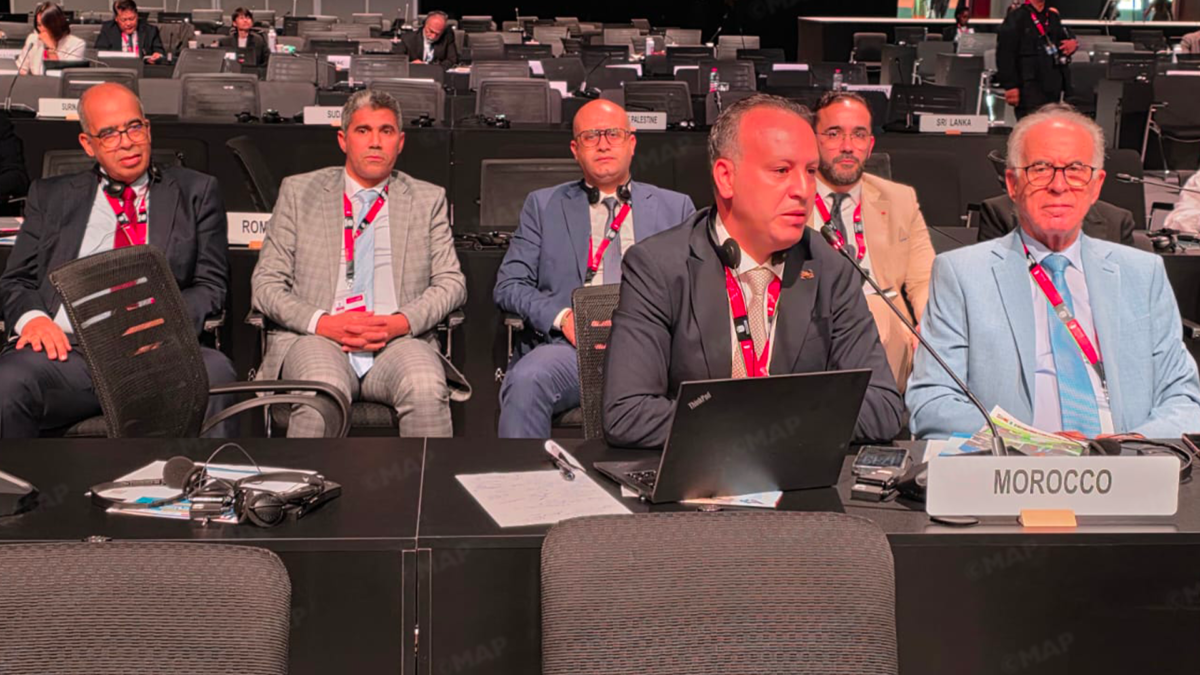
Abu Dhabi – Morocco’s experience in evidence-based crime prevention was highlighted on Monday in Abu Dhabi during the plenary session of the 15th United Nations Congress on Crime Prevention and Criminal Justice (September 26–October 1, 2026).
Speaking on behalf of the Moroccan delegation at the conference on “Promoting Innovative and Evidence-Based Crime Prevention Strategies for Social, Economic, and Environmental Development,” Hicham Mellati, Director of Criminal Affairs, Pardons, and Crime Monitoring at the Ministry of Justice, emphasized the main pillars of Morocco’s criminal justice response: a forward-looking national criminal policy based on evidence and a human-centered justice system.
In this regard, he emphasized Morocco’s commitment and firm resolve to give crime prevention the attention it deserves, recognizing it as a crucial lever in the fight against crime, based on two complementary dimensions: proactive crime detection and recidivism reduction.
The Kingdom’s criminal justice response is thus based on several complementary approaches, foremost among them the use of factual data, a human-centered approach, complementarity with public policies, and the involvement of civil society, he explained.
In this context, Mr. Mellati reviewed the creation of the National Crime Observatory, an institutional mechanism serving a data-driven and evidence-based criminal justice policy. Tasked with observing and analyzing criminal activity, the Observatory provides the relevant authorities with a reliable knowledge base for developing and evaluating criminal justice policy.
He explained that the Observatory adopts a participatory approach, bringing together various stakeholders within two working groups: a technical group and a scientific group. These groups include judicial institutions, represented by the Public Prosecutor’s Office and the High Council of the Judiciary, as well as the National Security services and the Royal Gendarmerie.
They also include representatives from several departments, institutions, and bodies, including the National Authority for Probity, Prevention, and the Fight Against Corruption (INPPLC) and the National Financial Intelligence Authority (ANRF). Furthermore, the Observatory engages with the academic community through partnerships with national universities, thereby strengthening the contribution of scientific research to criminal justice decision-making.
Mr. Mellati indicated that the Observatory has, to date, conducted several studies on crime in Morocco from a national perspective, taking into account the specific characteristics of the criminal phenomenon, whose determinants and causes differ from one country to another, while also relying on internationally adopted indicators.
In this regard, the Observatory relies on national judicial and security institutions, which have specialized units for collecting, recording, and analyzing data related to criminal activity. This facilitates the provision of the necessary data and information.
As part of strengthening analytical tools, Mr. Mellati stated that work is continuing on the development of a national crime map. This map will be created through a computer application that allows for the geolocation of crimes and the monitoring of their frequency across the country, in order to support decision-making in criminal justice and to better target prevention measures.
Regarding the social dimension of the session’s theme, he noted that the criminal justice response in Morocco is based on a human-centered approach, whether for the victim or the perpetrator of the offense, through the updating of the national legislative framework and the implementation of institutional reforms to serve this objective.
In this regard, he cited the strengthening of social assistance within the judicial system, specifying that Moroccan courts currently employ more than 500 social workers responsible for providing socio-legal services to users of the justice system, particularly victims, and supporting them throughout the various stages of the legal process.
Support units for women and children who are victims of violence have also been established, as well as shelters for victims of human trafficking in
Related articles
Under HM the King’s Impetus, Morocco Places Water Security at Heart of National Priorities – Ambassador
Rome – Under the impetus of HM King Mohammed VI, Morocco has placed water security and climate adaptation…

Guinea-Bissau Reaffirms ‘Clear and Consistent’ Stance Backing Morocco’s Territorial Integrity and Sovereignty over its Sahara
United Nations (New York) – The Republic of Guinea-Bissau on Saturday, September 26, 2026, reaffirmed its “clear, consistent…
Al-Quds University’s Chair of Moroccan Studies Highlights Morocco’s Centuries-Old Presence in Holy City
Al-Quds – The Chair of Moroccan Studies at Al-Quds University inaugurated the new academic year on Saturday by…