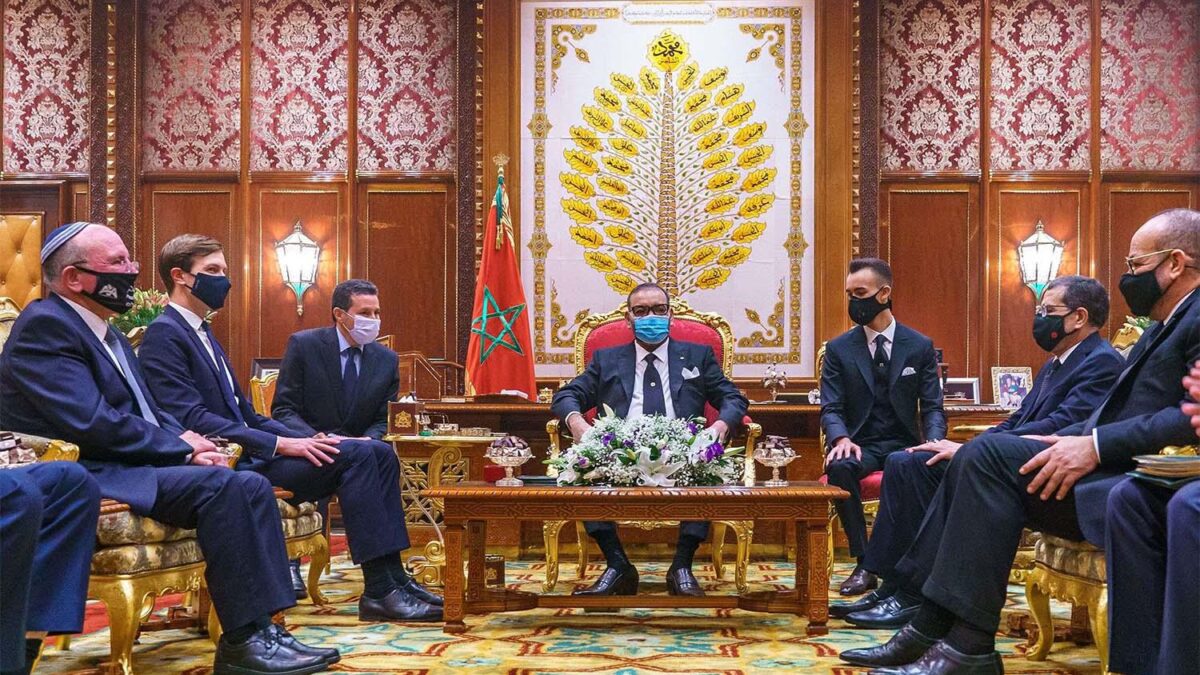
The Tapestry of Faith and Diplomacy: Morocco, Jewish History, and the Abraham Accords
In the winter of 2020, when Morocco officially signed the US-brokered Abraham Accords and agreed to resume diplomatic relations with Israel, many international observers viewed it as a modern breakthrough driven by strategic realpolitik. Yet inside the kingdom, the move felt less like a sudden pivot and more like the natural continuation of a conversation centuries in the making. To understand the contemporary Moroccan development within the Abraham Accords, one cannot simply look at trade figures or regional security pacts; one must look at the deep, centuries-old roots of Jewish history in the kingdom and the unique protective role played by its monarchy.
A Two-Thousand-Year Sacred Trust
The Jewish presence in Morocco predates the arrival of Islam in North Africa. Following the destruction of the Second Temple in Jerusalem, waves of Jewish refugees settled among the native Amazigh (Berber) tribes of North Africa, forging deep cultural, linguistic, and economic ties. Centured centuries later, during the Spanish Inquisition and the expulsion from the Iberian Peninsula in 1492, tens of thousands of Sephardic Jews found refuge across the Strait of Gibraltar.
Over generations, Jewish life became intimately interwoven into the fabric of Moroccan society. In towns from Fez and Marrakech to Essaouira, the Mellah—the historic Jewish quarter—stood alongside Muslim neighborhoods. Jewish artisans, traders, and scholars contributed heavily to Moroccan heritage, creating a distinct Andalusian-Moroccan tradition where Hebrew and Arabic echoed off the same stone walls.
The Monarchy and the Sacred Shield
Central to this history of coexistence is the Alaouite monarchy. As Amir al-Mu’minin (Commander of the Faithful), the King of Morocco holds a constitutional and religious duty to protect all “People of the Book” living within his realm. This commitment was dramatically put to the test during World War II under French colonial rule.
When the Nazi-aligned Vichy regime demanded that Sultan Mohammed V (later King) enact anti-Semitic laws and turn over the kingdom’s quarter-million Jewish citizens, the Sultan famously refused. He famously declared that there were no Jewish or Muslim subjects—only Moroccans. By refusing to enforce Vichy orders, Mohammed V sheltered the Jewish population from the horrors of the Holocaust, a courageous stance that remains a cornerstone of national pride.
This tradition of active patronage continued under King Hassan II and has reached new heights under the current sovereign, King Mohammed VI. Recognizing that national identity relies on all its historical streams, King Mohammed VI spearheaded an unprecedented national effort to preserve Jewish heritage. Under his direction, the kingdom restored over 160 historic Jewish cemeteries, renovated historic synagogues, reinstated original Hebrew street names in ancient Mellahs, and established Bayt Dakira (“House of Memory”) in Essaouira—a museum dedicated to the shared spiritual heritage of Moroccan Muslims and Jews. In 2011, Morocco took the extraordinary step of explicitly enshrining its “Hebraic component” in its national constitution as a foundational element of its identity.
A Legacy of Institutional Tolerance
While mass migrations in the mid-20th century saw the vast majority of Moroccan Jews relocate to Israel, France, and North America, the emotional tie between Morocco and its diaspora never dissolved. Unlike many regional nations where Jewish emigration led to a complete erasure of history, Morocco maintained an open heart.
Today, Morocco is home to the largest remaining Jewish community in the Arab world. More importantly, it remains a rare space where Jewish personal status laws (such as marriage and inheritance) are officially recognized by the state and presided over by rabbinical courts funded by the government. Moroccan school curricula include Jewish history and Holocaust education, teaching new generations that tolerance is not merely an abstract ideal, but an essential historical reality.
Political Relations and the Abraham Accords
When Morocco rejoined diplomatic ties with Israel under the Abraham Accords in December 2020, the foundation was already firmly laid. Informal channels, intelligence sharing, and cultural exchanges had existed for decades, notably under King Hassan II, who acted as a quiet mediator in several Middle East peace initiatives.
The formalization of ties was accelerated by a pragmatic bargain: the United States recognized Moroccan sovereignty over the Western Sahara, while Morocco agreed to reopen official liaison offices with Israel, establish direct commercial flights, and expand bilateral cooperation.
The practical outcome of the accords was immediate:
- Cultural and Tourism Boom: Direct flights brought hundreds of thousands of Israeli tourists—many of Moroccan heritage—back to the land of their ancestors. Families reconnected, pilgrimages (Hiloula) to the tombs of revered Moroccan Jewish saints surged, and cross-border cultural partnerships flourished.
- Economic & Security Partnerships: Morocco and Israel expanded trade, investment, and technological collaboration in key sectors like agriculture, water management, green energy, and defense technology.
- Diplomatic Balancing: Throughout the strategic evolution of the Accords, Morocco has maintained its stance as a mediator. By leveraging its unique position, the kingdom continues to advocate for a two-state solution and the rights of the Palestinian people while maintaining its official diplomatic channels with Israel—proving that regional normalization need not abandon core principles.
A Model for the Future
The Moroccan experience within the Abraham Accords demonstrates that lasting peace cannot simply be negotiated in foreign conference rooms or written into policy papers; it must be backed by genuine historical memory and human connection.
Where other diplomatic agreements often feel transactional, Morocco’s participation in the Abraham Accords is underpinned by a deep-seated cultural truth: for Moroccans, Jewish history is not the history of “the other”—it is an indelible chapter of their own story. By honoring its past and protecting its unique pluralism, Morocco offers the broader region a powerful model for how historical tolerance can build a more integrated, peaceful future.
Related articles
Dakhla Launches New Engineering School of Advanced Technologies
Dakhla – Ibn Zohr University University on Monday officially launched the academic activities of the National School of…
The Es-Semara Provincial Council Approves the 2027 BudgetEs-Semara
The Es-Semara Provincial Council, meeting in its regular September session on Monday, approved the draft budget for the…
Al-Quds University’s Chair of Moroccan Studies Highlights Morocco’s Centuries-Old Presence in Holy City
Al-Quds – The Chair of Moroccan Studies at Al-Quds University inaugurated the new academic year on Saturday by…