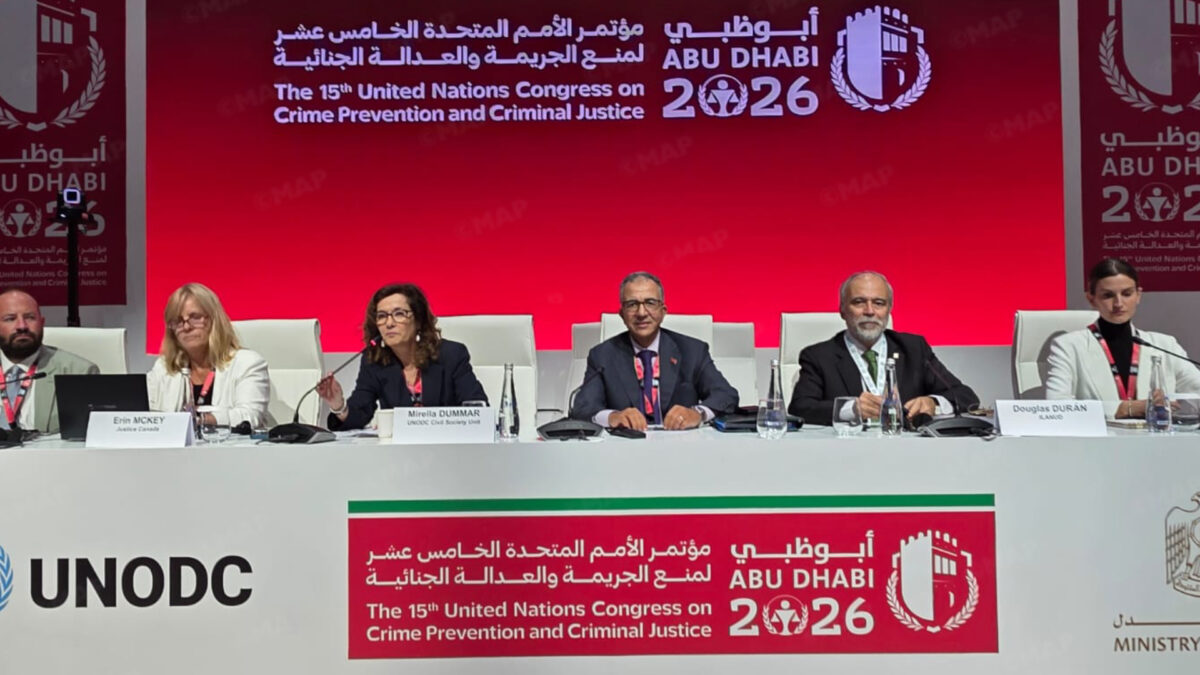
Abu Dhabi – In line with the High Guidelines of His Majesty King Mohammed VI, Morocco will continue to promote an approach to crime prevention and criminal justice based on cooperation, prevention, human dignity, institutional capacity-building and international solidarity, affirmed on Saturday in Abu Dhabi the Kingdom’s Ambassador and Permanent Representative to the UN organizations in Vienna, Azzedine Farhane.
Speaking during a session dedicated to regional and civil society contributions at the 15th UN Congress on Crime Prevention and Criminal Justice (Sep. 26 to Oct. 1st), Farhane said that this approach rests on the involvement of all stakeholders, mainly civil society actors.
In this respect, he highlighted Morocco’s experience in hosting the Western Asia Regional Preparatory Meeting in April 2025, which reinforced the conviction that multilateralism is strongest when global commitments are rooted in regional realities, regional cooperation is strongest when it is nationally owned, and national action is strongest when it is inclusive of society as a whole.
He noted that hosting the meeting was not simply an organizational responsibility, but rather reflected a deeper conviction that global responses to crime prevention and criminal justice are stronger when they are built upon regional realities, national experiences, and the voices of those working closest to communities.
Farhane thus highlighted five lessons from Morocco’s experience, the first of which concerns taking into account regional specific features. While transnational crime is global in its reach, its manifestations, vulnerabilities, and consequences are often local and regional, he explained, adding that regional preparatory meetings provide therefore an essential bridge between national realities and global norm-setting.
“Our experience demonstrated the importance of creating a space where countries of the region could identify their own priorities, exchange experiences and contribute collectively to the global discussion,” he said.
The second lesson concerns inclusiveness, which strengthens both legitimacy and effectiveness. Against today’s complex criminal challenges, governments cannot act alone, Farhane noted, highlighting the contributions of civil society, academia, practitioners, young people, the private sector, and local communities.
Their participation should therefore not be understood merely as a consultation, but should rather increasingly become part of a genuine culture of co-construction, in which different stakeholders contribute to identifying challenges, designing responses, and supporting implementation, he maintained.
The third lesson is that regional diversity should be transformed into a source of global convergence. Different regions may approach crime prevention and criminal justice from different historical, institutional, and social perspectives. However, diversity does not prevent consensus, the diplomat pointed out.
When it is channelled through dialogue, diversity can enrich multilateral decision-making and transform diverse experiences into shared priorities and, ultimately, into common international commitments, he explained.
The fourth lesson concerns the preservation of the continuum between consultation, negotiation, and implementation. The Abu Dhabi Declaration should not represent the end of the preparatory process. It should mark the beginning of a new phase, Farhane said.
“The ideas generated in the regions, including those advanced by civil society, should continue to accompany us when we translate the Declaration into concrete action,” he added.
In this respect, he recommended establishing stronger mechanisms of follow-up between the Crime Congresses, enabling regional actors and civil society organizations to contribute not only to the preparation of international commitments, but also to their implementation and assessment.
The fifth lesson is that partnerships must be translated into concrete actions. The complexity of contemporary crime, from organized criminal networks and corruption to cybercrime, trafficking and emerging forms of technologically enabled crime, requires us to move beyond institutional silos, he maintained.
He called in this regard for stronger interaction among governments, the United Nations Office on Drugs and Crime (UNODC), civil society, academia and other relevant stakeholders, as well as greater complimentarity among the international instruments and mechanisms dealing with transnational organized crime, corruption, terrorism, and other interconnected threats.
“The objective should be clear: to transform institutional coordination into operational cooperation and operational cooperation into concrete results for our societies,” he stressed.
Farhane added that “the true measure of the success of this Congress will ultimately not be only the Declaration we adopt, but our collective capacity to transform regional voices into global commitments, global commitments into national action, and national action into greater justice, security and trust for our citizens.”
Related articles

Breakdancing: B-Boy Billy and B-Girl El Mamouny secure their spot in the Red Bull BC One World Final in Toronto
Casablanca – B-Boy Billy and B-Girl El Mamouny won the national qualifiers for the Red Bull BC One…
Moroccan Police in Tangier Arrest Five Suspects in Case Involving Bag Containing Ballots
Tangier – Five individuals have been arrested in connection with the case involving the detention of a person…
Moroccan Police in Tangier Arrest Five Suspects in Case Involving Bag Containing Ballots
Tangier – Five individuals have been arrested in connection with the case involving the detention of a person…