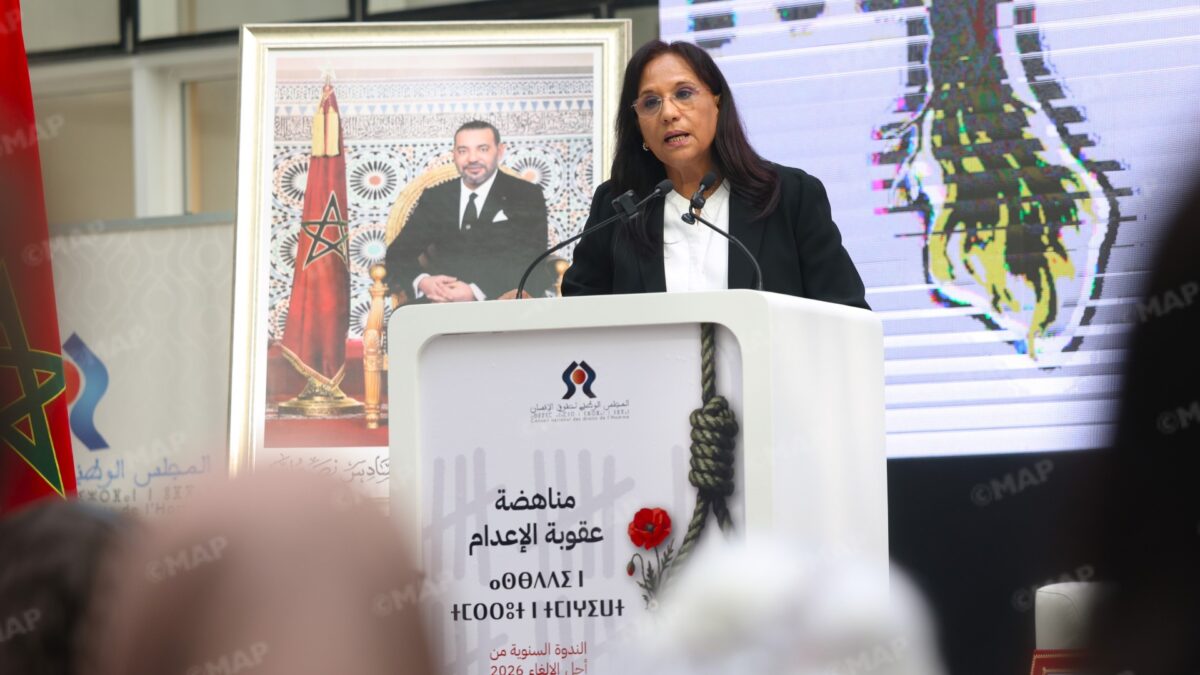
Rabat – The President of the National Human Rights Council (CNDH), Amina Bouayach, stressed on Tuesday in Rabat the need to humanize the debate on the death penalty, stating that this approach “refuses to consider the deprivation of life as an instrument for rendering justice.”
Speaking at a press conference on the occasion of the World Day Against the Death Penalty, Bouayach explained that humanizing the debate in no way means mitigating the gravity of the crime or placing the victim and the perpetrator on an equal footing. Rather, it forces society to face itself and test its humanity through the search for preventive and inclusive solutions that prevent the recurrence of such tragedies.
The CNDH President called on the executive and legislative branches to “seize the political moment” and work toward transitioning from a de facto moratorium to total legal abolition.
For his part, the coordinator of the Moroccan Coalition Against the Death Penalty (CMCPM), Abderrahim Jamaï, reviewed the global challenges facing the protection of the right to life. He noted the importance of synergizing the efforts of human rights actors and civil society to counter any international or regional regression in this area.
He also praised the positive momentum underway in Morocco, welcoming the Kingdom’s decision to host the 10th World Congress Against the Death Penalty in Marrakech as “a political commitment reflecting the will to strengthen the human rights system and paving the way to crowning this journey with total abolition.”
Jamaï called for capitalizing on this momentum to mobilize all actors, particularly the youth, so they can get involved in the preparations for this important international event.
Meanwhile, the Director General of the association Together Against the Death Penalty (ECPM), Raphael Chenuil-Hazan, noted that Morocco’s maintenance of the execution moratorium since 1993 and its vote at the United Nations in favor of the resolution for a moratorium on the application of the death penalty have strengthened the Kingdom’s position on the international human rights stage.
The hosting of the upcoming World Congress by the city of Marrakech constitutes an exceptional prospect and an opportune moment to transform the de facto moratorium into a total abolition enshrined in the Penal Code, which will be “the crowning achievement of a long journey of advocacy and commitment to human rights,” he observed.
In the same context, the Deputy Head of the European Union (EU) Delegation to Morocco, Daniele Dotto, dwelt on the human dimension of the suffering of the condemned. He pointed out that the general global trend leans toward abolition, while welcoming the positive momentum and tangible developments on the African continent, which is now at the forefront of this movement.
Reiterating the EU’s support for Morocco in organizing the World Congress, he considered this step to be “a strong signal of leadership and confidence.” Likewise, Dotto highlighted the Union’s constant commitment alongside institutions and civil society to achieve this goal.
The representative of the Moroccan Prison Observatory (OMP), Abdallah Mouseddad, emphasized the slogan chosen for this year’s Day, “Testify for Life,” noting its role in highlighting the devastating repercussions suffered by the condemned and their families, as well as in combating the culture of revenge.
He also insisted on the need to engage in efforts aimed at developing an African protocol in favor of abolition, to pay particular attention to the mental health of current inmates, and to strengthen reintegration programs.
The meeting culminated in the publication of a final declaration by the participants, calling on the government to include the abolition of the death penalty among its legislative reform priorities and to remove it from the Penal Code. The declaration also urged Parliament to “put an end to legislative hesitation,” urging it to ratify the Second Optional Protocol without delay.
During this meeting, speeches and remarks were delivered by representatives of professional networks against the death penalty, highlighting the commitment of various sectors to this pro-human rights approach.
This event was also distinguished by the presence of representatives of the diplomatic corps accredited to Morocco, as well as representatives of public institutions, including the National Authority for Probity, Prevention and the Fight against Corruption, the Institution of the Ombudsman of the Kingdom, and the Council of the Moroccan Community Abroad.
Related articles
Artificial Intelligence Requires Understanding Its Limitations and Defining Ethical Safeguards (Head of the Public Prosecutor’s Office)
Fez – The King’s Prosecutor General at the Court of Cassation, Head of the Public Prosecutor’s Office, Hicham…
Rabita Mohammadia of Ulemas: Mr. Abbadi Advocates for Religious Discourse Relevant to Contemporary Issues
Rabat – The Secretary General of the Rabita Mohammadia of Ulemas, Ahmed Abbadi, advocated on Saturday in Rabat…