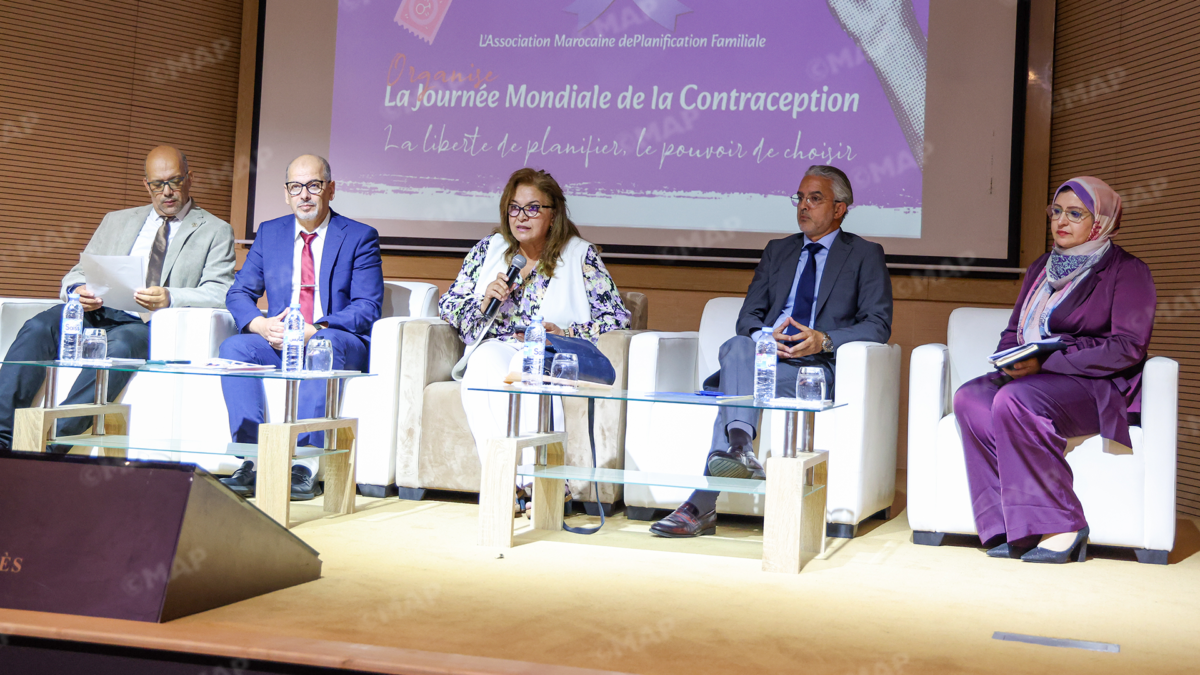
Rabat – Representatives from NGOs and institutions, academics, and healthcare professionals advocated for quality family planning services on Tuesday in Rabat, at a scientific conference held to commemorate World Contraception Day.
Organized by the Moroccan Association for Family Planning (AMPF), with support from the United Nations Population Fund in Morocco (UNFPA) and the pharmaceutical group Bayer-Morocco, this conference, themed “Contraception, a Choice and a Right for All: The Freedom to Plan and the Power to Choose,” provided an opportunity to promote access to reliable information and quality family planning services based on rights and respect for choice.
The conference also strengthened the dialogue surrounding the necessary mechanisms to empower women and young people to make informed choices about their reproductive health.
This event was also marked by the official launch in Morocco of the joint initiative “Empowering Choices,” led by UNFPA with the support of Bayer-Morocco, in collaboration with the Ministry of Health and Social Protection and civil society organizations.
This initiative aims to strengthen access to information and family planning services, support capacity building for healthcare professionals, and contribute to greater awareness of sexual and reproductive health.
Speaking at the event, Ms. Hanane Rassimi, Head of the Family Planning Service at the Ministry of Health and Social Protection, stated that family planning is now recognized not only as a pillar of maternal health, but above all as a crucial tool guaranteeing couples’ right to make decisions about their reproductive choices.
In this regard, she highlighted the profound demographic and social transformations taking place in Morocco, adding that they necessitate a rethinking of traditional approaches to family planning.
For his part, the executive director of the Moroccan Association of Family Planning (AMPF), Abdellatif Maamri, indicated that the meeting aims to highlight the importance of family planning and raise awareness about the true purpose of contraception, which is wrongly reduced to a mere tool for preventing procreation.
Far from simply being a deterrent to birth rates, family planning is an essential health service primarily intended to preserve the health and well-being of mothers and children, he explained.
For his part, the head of the UNFPA office in Morocco, Mahdi Halmi, emphasized the need to elevate family planning to the status of a human right, moving beyond the simple logic of population control. He affirmed that family planning remains a crucial issue focused on quality counseling, equitable access, and a diversity of choices.
The UN official also detailed the actions planned under the new “Empowering Choices” initiative, which focus primarily on digitizing patient monitoring and contraceptive management, equipping eight referral health centers, and organizing mobile “Classes for Spouses” units.
The director of the Pharma division at Bayer-Morocco, Anas Ziati, emphasized that access to contraception extends beyond healthcare alone, encompassing freedom of choice, equal opportunities, and sustainable development.
He noted that more than 200 million women worldwide still lack access to contraception, asserting that empowering women to plan their pregnancies is a fundamental right that enables them to pursue their education, actively participate in the economy, and strengthen the resilience of their communities.
The Bayer representative also highlighted the group’s ambitious goal of expanding access to modern contraceptive methods to 100 million women in low and middle-income countries by 2030.
Related articles
Scientific Knowledge and Professional Conscience: Guarantees of Excellence for Future Dentists (University Leader)
Rabat – The acquisition of solid scientific skills, combined with the development of genuine professional conscience, is an…

Rabat Business School Achieves Triple Crown of International Accreditations
Rabat – Rabat Business School, the management school of the International University of Rabat (UIR), has reached a…
Dakhla Launches New Engineering School of Advanced Technologies
Dakhla – Ibn Zohr University University on Monday officially launched the academic activities of the National School of…