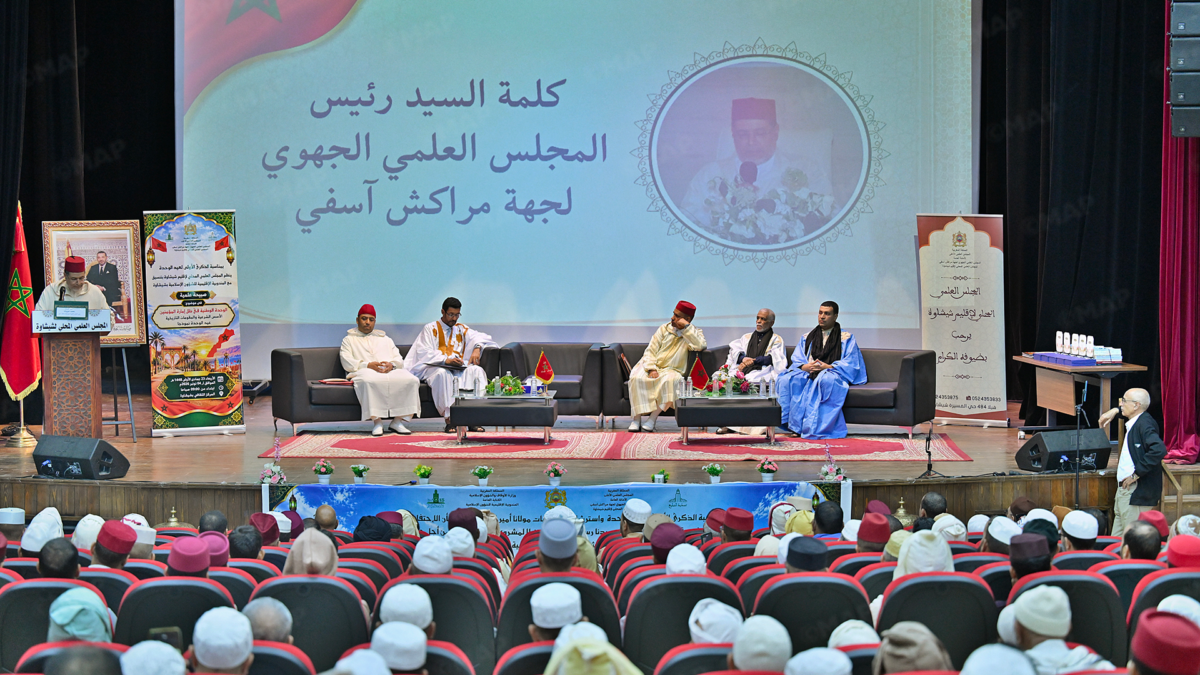
Chichaoua – “National Unity Through the Lens of the Imarat Al Mouminine: Religious Foundations and Historical Components, Eid Al Wahda as a Model” is the theme of a meeting held Wednesday in Chichaoua, with the participation of numerous Islamic scholars and presidents of Islamic scholars’ councils, as well as religious affairs officials.
Initiated by the Local Council of Ulema of the Chichaoua Province, in coordination with the Provincial Delegation of Islamic Affairs, this meeting is part of the celebration of the first anniversary of Unity Day, while also drawing inspiration from the High Directives of His Majesty King Mohammed VI, Commander of the Faithful, regarding the celebration of the 1500th anniversary of the birth of the Prophet Muhammad (peace be upon him), and within the framework of the implementation of the “Tasdid Attabligh” project for a better life.
In this context, the speakers highlighted the historical and religious depth of national unity, considered the fruit of a continuous process of cohesion between the Glorious Alaouite Throne and the Moroccan people, founded on legitimate allegiance (Bayya) and the Imarat Al Mouminine (the Commander of the Faithful), and which has contributed, throughout different stages of history, to the preservation of the Kingdom’s unity and its enduring principles.
Speaking on this occasion, the president of the local Council of Ulema of the province of Chichaoua, Abdellah El Azhari, emphasized the role of the Councils of Ulema in guiding religious and intellectual debate and strengthening awareness of the Kingdom’s religious and national principles, underscoring in this regard the central place occupied by the institution of the Imarat Al Mouminine in guaranteeing the unity of the Ummah and preserving its cohesion.
Such meetings offer an opportunity to examine the religious foundations and historical extensions of national unity, while also highlighting the links between the Kingdom’s historical memory, its current challenges, and its future aspirations. Furthermore, they emphasize the importance of instilling the values of citizenship, cohesion, and attachment to Moroccan identity in different generations, he noted.
For his part, the provincial delegate for Islamic Affairs, Abdellah Kharouach, observed that the mention of “Eid al-Adha” during this meeting embodies the concrete scope of the “Tasdid Attabligh” project, through the consolidation of the fundamental principles of religion, the preservation of national unity and social stability, and the promotion of the values of serenity, mutual support, and solidarity.
The Ministry of Religious Endowments and Islamic Affairs, through its provincial delegation in Chichaoua, he added, assumes a role of guidance and spiritual support, particularly by ensuring respect for the sanctity of mosques, directing Friday sermons and preaching classes, and supervising religious officials, with a view to upholding the religious and national principles of the Kingdom, especially the Ash’ari doctrine, the Maliki rite, Sunni Sufism, and devotion to the Glorious Alawite Throne.
The program of this scientific meeting featured three presentations by the presidents of the local councils of Islamic scholars (Ulema) from the southern provinces of the Kingdom. These presentations focused on the history of the Moroccan Sahara in the construction of the state and society, the main historical milestones marking the completion of national and territorial unity, and the foundations of the state and the nation in light of the Royal Address of October 31, 2025, particularly regarding national unity and economic empowerment.
Through their presentations, the presidents of the local councils of Islamic scholars from Guelmim, Laâyoune, and Aousserd unanimously emphasized the importance of recalling the historical significance of the Moroccan Sahara in the history of the state and society, as well as the deep ties that have bound the southern provinces to the rest of the Kingdom throughout different historical periods.
The interventions also highlighted the centrality of religious and national constants in preserving the unity of the Kingdom, as well as the importance of continuing to consolidate national achievements, alongside support for development and economic empowerment, in service of social cohesion and strengthening the attachment of generations to their national identity.
Related articles
World Heritage Preservation and the Habitability of Historic Cities Under Discussion in Marrakech
Marrakech – The challenges of preserving World Heritage and the issue of the habitability of historic cities were…
Supporting Rural Women, a True Catalyst for Socio-Economic Integration and Empowerment
Fquih Ben Salah – The empowerment of rural women and the strengthening of their role in the process…
Marrakech Hosts 1st Moroccan Sahara Innovation Challenge
Marrakech – The first edition of the Moroccan Sahara Innovation Challenge 2026 was launched on Monday in Marrakech,…