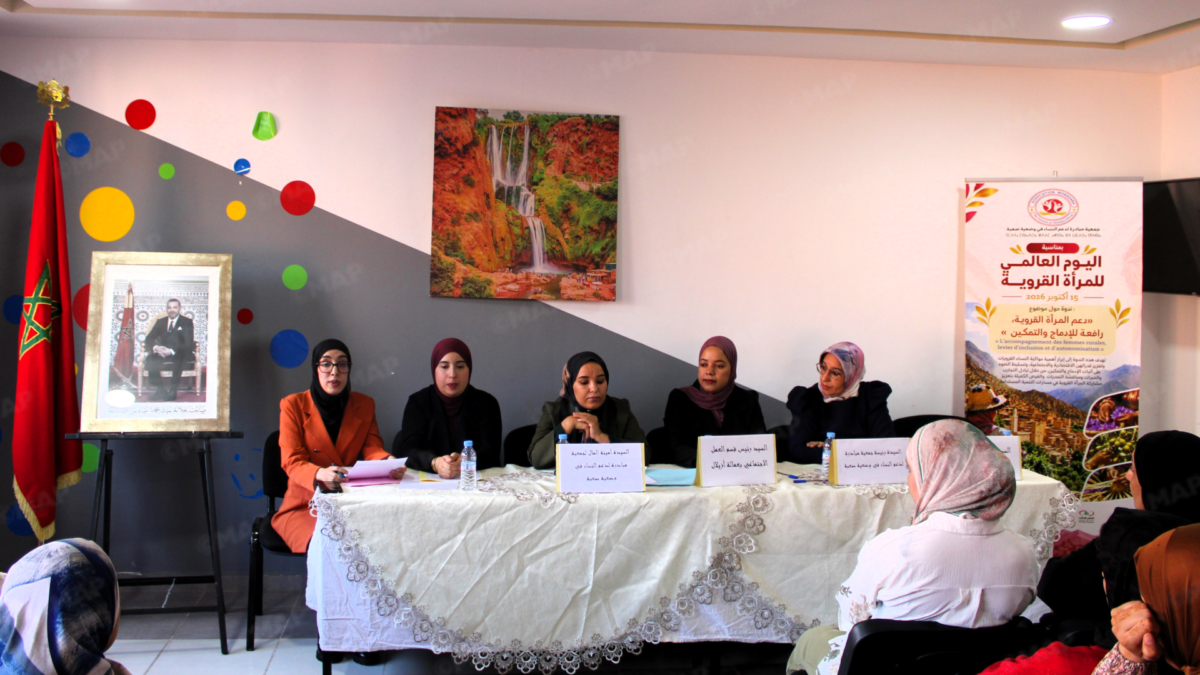
Azilal – The socio-economic empowerment of rural women and the examination of ways to support and integrate them into the development process were the focus of a communication and training session recently held in the province of Azilal, under the theme “Supporting Rural Women: A Lever for Integration and Empowerment.”
This meeting, which brought together representatives from government departments and public institutions, as well as representatives from civil society organizations, is part of ongoing efforts to highlight the role of rural women in the various interventions of the National Initiative for Human Development (INDH), and in programs dedicated to improving their living conditions and strengthening their financial independence.
In this regard, Naima Aachaq, representative of the Social Action Division (DAS) at the Azilal provincial prefecture, highlighted the tireless efforts of the Initiative to support economic empowerment through the “Income Improvement and Economic Inclusion of Youth” program. She noted that the period from 2019 to 2026 saw the funding of 54 women’s cooperatives, encompassing approximately 200 women, for a total of over 10.5 million dirhams.
This financial and logistical support, Ms. Aachaq added, also facilitated the creation of 83 women-owned businesses, with financial support of nearly 8 million dirhams, demonstrating the importance of initiatives aimed at promoting women’s entrepreneurship.
In a statement on this occasion, the Head of the DAS (Directorate of Social Action) at the same prefecture emphasized the Initiative’s interventions through the “Boosting Human Capital for Future Generations” program. Regarding support for education, he specified that 34 “Dar Taliba” (Student Houses), distributed across the province’s various rural communes, have been established and equipped, in addition to contributions to school transportation. These actions aim to combat school dropout rates and encourage rural girls to pursue their studies.
Regarding maternal and child health, the official noted that interventions primarily target reducing maternal and infant mortality and improving access to care, through, among other things, the support and equipping of 12 “Dar Al Oumouma” (Maternity Homes).
He also highlighted, in the same vein, the deployment of a network of “Community Women Liaisons” dedicated to supporting and guiding pregnant women, noting that the province now has 170 community liaisons.
Regarding the protection of vulnerable groups, the official noted that the National Initiative for Human Development (INDH) supports women in precarious situations through two centers dedicated to women in difficult circumstances, benefiting some 200 women annually, in partnership with National Mutual Aid organizations and local associations.
For her part, the representative of the Provincial Delegation of National Mutual Aid, Hiba Ait Tabia, emphasized the significant contribution of rural women to local development, whether through agricultural and artisanal activities or their role in preserving ancestral traditional knowledge.
She also presented a report on the services offered by the training centers under the Delegation, highlighting the important role of social establishments in supporting vulnerable people, protecting women victims of violence and guaranteeing their socio-economic integration.