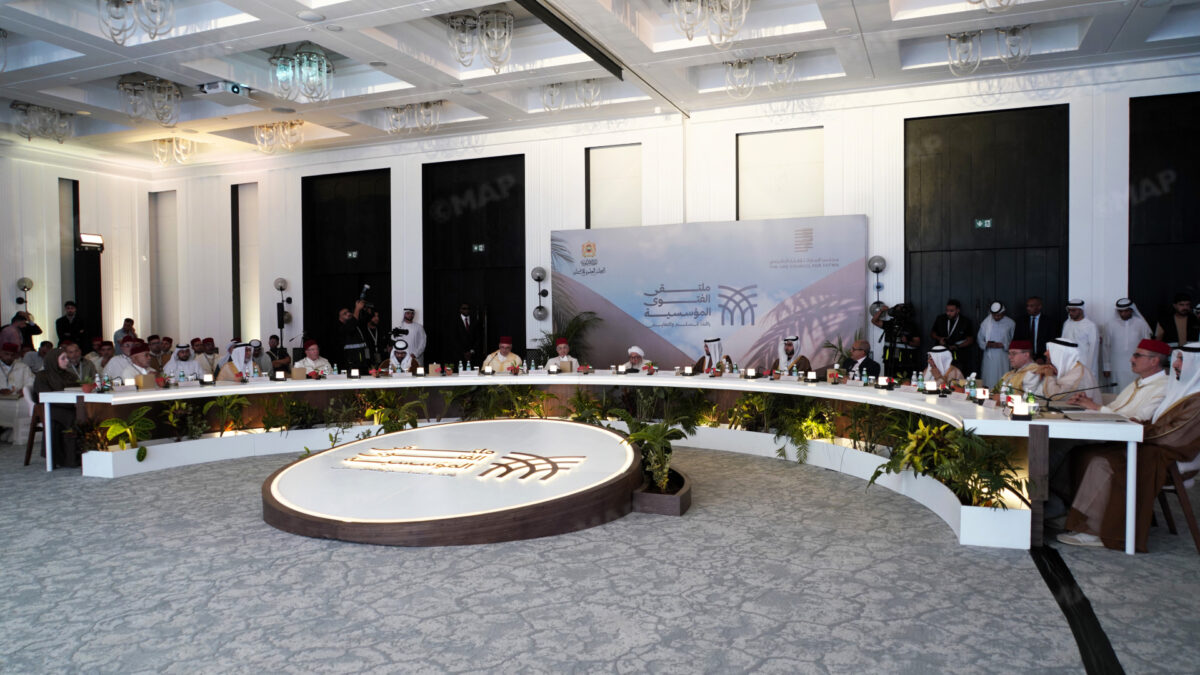
Salé – A scientific forum on the theme “Institutional Fatwas: A Lever for Peace and Coexistence” opened Thursday in Salé, at the initiative of the Higher Council of Ulema and the Fatwa Council of the United Arab Emirates.
Organized over two days, this meeting aims to consolidate the prospects for long-term scientific cooperation between the two institutions, with a view to deepening the methodological and scientific approaches to institutional fatwas and strengthening the foundation of the values of peace, coexistence, facilitation, and moderation.
This event also seeks to highlight the pioneering role of the two Councils in the development of institutional fatwas, the preservation of national principles, and the promotion of the values of tolerance in Islam, while ensuring that the field of fatwas is protected from individual opinions and interpretations lacking institutional frameworks.
Speaking on this occasion, the Secretary General of the Higher Council of Ulema, El Yazid Er-Radi, emphasized that this initiative is likely to strengthen cooperation between the two brotherly countries and give new impetus to their bilateral relations.
He continued, stating that institutional fatwas, issued within a rigorous and structured framework, contribute to the development of balanced individuals and the strengthening of social cohesion, while promoting an understanding of religion based on the values of tolerance, moderation, and balance, as well as the ease with which its precepts can be put into practice.
Mr. Er-Radi also noted that Morocco, fully aware of the importance of institutional fatwas and their fundamental role in preserving the religious sphere, has worked to regulate this function within its structures dedicated to organizing scholarly and religious life.
To this end, the Kingdom has established, within the Higher Council of Ulema, the Scientific Commission for Fatwas, whose role is to issue fatwas on general matters, he added, noting that the regional and local councils of ulema are responsible for providing answers to religious questions and formulating legal opinions on issues related to the daily lives of citizens.
While welcoming these initiatives, Mr. Er-Radi emphasized the importance of supporting them due to their beneficial scientific and religious impact, as well as their role in strengthening the privileged relationship between Morocco and the United Arab Emirates, and their respective leaders.
For his part, Sheikh Abdullah bin Bayyah, Chairman of the UAE Fatwa Council, stated that this meeting demonstrates the particular interest both Councils have in fatwas, the practical application of Islamic jurisprudence (Fiqh), and the impact of religious discourse on preserving peace and coexistence.
He added that this forum embodies the depth of the fraternal and strong relations uniting the two countries, the foundations of which were laid by the late King Hassan II and the late Sheikh Zayed bin Sultan Al Nahyan, and which continue to be strengthened and developed under the reign of His Majesty King Mohammed VI and His Highness Sheikh Mohammed bin Zayed Al Nahyan, President of the UAE.
At the same time, Sheikh Abdullah bin Bayyah emphasized the need to regulate and institutionalize the fatwa process in light of the complexity of legal issues related to various aspects of life. He explained that the fatwa is no longer limited to a meeting between the petitioner and the mufti, but that its dissemination now extends to a vast digital space, where rulings are extracted from their original context, disseminated independently of their temporal and spatial framework, and can be used outside of their original context.
The first day of this forum was marked by the signing of a book on the family within the context of Islamic jurisprudence (fiqh), the result of the work of the 3rd International Conference of the UAE Fatwa Council.
It also featured the screening of video presentations on the two councils’ experience with institutional fatwas, in addition to the organization of a scientific session.
Through this forum, the two councils aim to review pioneering institutional models and experiences in the field of fatwa and draw lessons from them for the institutional governance of fatwa, to develop methodologies for understanding and classifying emerging issues, and to leverage the existing knowledge.
Related articles
Lalla Asmaa University, Model of Unique Inclusive Education Worldwide – Officials
Rabat – Lalla Asmaa University, inaugurated Thursday in Rabat by Her Royal Highness Princess Lalla Asmaa, President of…
Morocco Dismantles 1,597 Migrant Smuggling, Human Trafficking Networks in 2021-2025 Period
Rabat – A total of 1,597 criminal networks involved in migrant smuggling and human trafficking were dismantled between…
Kick-off of the 8th Peruvian Gastronomic Festival
Casablanca – The 8th edition of the Peruvian Gastronomic Festival opened Wednesday evening in Casablanca, an initiative of…