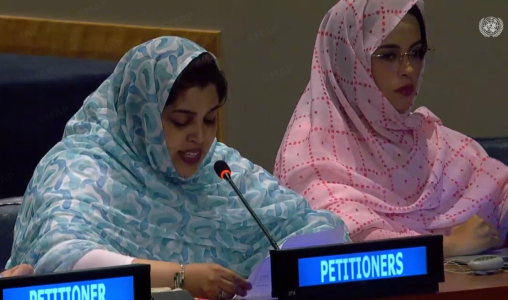
United Nations (New York) – Elected representatives from the Kingdom’s Southern Provinces addressed the Fourth Committee of the United Nations General Assembly in New York on Thursday, providing evidence and figures to demonstrate the significant democratic growth and dynamic development currently taking place in the Moroccan Sahara region.
Speaking to the Committee members, Moufida Ouiddad, a young member of parliament recently elected to the House of Representatives in the September 23 legislative elections, expressed her pride in “embodying the image of a generation of Sahrawi women whose presence in public life has become a tangible reality within elected institutions and in decision-making positions.”
Representative legitimacy, she emphasized, “is neither a mere claim nor an indefinite mandate,” affirming that, as an elected official, she was invested “with a mandate whose source, duration, and value I fully understand, reflecting the trust the Sahrawi people have placed in me.”
Taking the floor in turn, the president of the Dakhla municipality, Hormatollah Erragheb, said he was honored to represent the second largest city in the Kingdom’s Southern Provinces, which has become “a promising economic hub and an Atlantic gateway open to the world.”
This dynamism, he argued, is the result of a vision “based on openness, investment, resource development, human capital development, and the integration of local development with national and international partnerships.”
This is one of the success stories unfolding daily in the Moroccan Sahara region, stated Mr. Erragheb, adding that “the Sahrawi people we know and represent do not want to live on the margins of the world, nor do they want to leave their children’s future to the illusions of certain parties who do not understand the meaning of democratic values and development.”
For his part, H’Mmaid Soubai, a councilor from the municipality of Foum El Oued, emphasized that his presence at the UN, alongside parliamentarians and members of the elected councils of the Southern Provinces, “is a continuation of the electoral legitimacy and the responsibility we assume towards the inhabitants of this part of the Kingdom.”
Speaking about the development momentum experienced by the cities and provinces of the Moroccan Sahara, Mr. Soubai stated that this growth demonstrates that “investment in infrastructure and human capital is, by its very nature, an investment in human dignity, which we also wish for our brothers in the Tindouf camps.”
Similarly, Takber Abba, a local elected official from the province of Boujdour, expressed her satisfaction that Sahrawi women are no longer simply beneficiaries of development policies, but full-fledged participants who contribute through their creativity, entrepreneurial spirit, and contribution to value creation.
Sahrawi women “are no longer objects of public policy, but rather economic actors, project leaders, business directors, and employers who participate in the local and national economy,” she asserted.
For his part, the mayor of Smara, Moulay Brahim Chrif, emphasized that although the city is geographically distant from the coast, it “has never been on the sidelines of the development dynamic experienced by other parts of the Southern Provinces.”
In this regard, he expressed his conviction that the Royal Initiative aimed at facilitating access for landlocked African countries to the Atlantic Ocean offers an opportunity to “integrate our inland cities into networks of connectivity, exchange, and investment.”
The true representation of the Sahrawi people “is neither proclaimed from the outside nor monopolized by a political slogan, but is built through the trust placed in them by citizens at the ballot box,” he insisted.
For her part, M’aidla Lebhaihe, recently elected in the September 23 parliamentary elections, stated that the election of Sahrawi women on local lists carries particular political significance.
The presence of women, she said, “is no longer solely linked to legal mechanisms designed to strengthen their representation,” adding that “they now choose to run on joint lists with men and conduct their electoral campaigns under the same political conditions.”
Related articles
HM the King Delivers Speech to Parliament at Opening of 1st Session of 1st Legislative Year of 12th Legislature
Rabat – His Majesty King Mohammed VI, may God assist Him, accompanied by HRH Crown Prince Moulay El…
A Vision for Renewal: King Mohammed VI Sets Parliament’s Strategic Course for the 12th Legislative Term
RABAT — In an address marking the state opening of the first session of the first legislative year…

Proven Collusion Between “polisario” and Terrorist Groups Operating in Sahel Exposed at UN
United Nations (New York) – The proven collusion between the separatist “polisario” movement and terrorist groups operating across…