
United Nations (New York) – The proven collusion between the separatist “polisario” movement and terrorist groups operating across the Sahel-Saharan region was denounced Wednesday before the United Nations Fourth Committee by a number of petitioners, who warned of the growing risks this situation poses to regional stability and security.
Addressing the Committee, Souleymane Satigui Sidibé, President of the Sahel Institute for Research and Analysis for Conflict Transformation, stressed that the issue of links between “polisario” militias and extremist movements is receiving increasing attention in the United States, reflecting what he described as a “qualitative shift” in the way the international community views the separatist movement militias, whose “terrorist excesses can no longer be ignored.”
This reality, he added, has triggered a “structured and bipartisan legislative process” in both chambers of the U.S. Congress, where Republican and Democratic lawmakers have introduced bills “designating the polisario as a terrorist organization.”
These initiatives have been spearheaded by around two-dozen prominent members of the U.S. House of Representatives and Senate, the petitioner recalled, emphasizing that the measures under consideration in Congress are based on “tangible evidence” demonstrating the collusion and involvement of “polisario” militias in terrorist and destabilizing activities across the region.
Echoing this assessment, Mohammad Ziyad Aljabari, representing the Moroccan-Palestinian Friendship Association, stated that several elements point to the recruitment of “polisario” members by terrorist organizations operating in the Sahel.
He cited, in particular, the activities of Adnan Abu Walid Al-Sahraoui within ISIS-affiliated groups, as well as reports alleging the involvement of separatist elements in attacks recently carried out in the Middle East.
In this regard, the petitioner warned against the recruitment of young people and children in the Tindouf camps in support of extremist agendas.
For his part, Abdul Basith Pattinathar, of the World Humanitarian Drive, called on the international community to pay greater attention to the links between separatism, terrorism, and transnational crime in fragile regions.
Aljabari also stressed the need to safeguard humanitarian zones from militarization, exploitation, or extremist influence and to ensure that humanitarian assistance effectively reaches the populations for whom it is intended.
Speaking on behalf of the Jordanian Philosophical Society, Amal Jbour highlighted growing concerns over the links between the separatist movement and terrorist networks operating in the Sahel, noting that such concerns have prompted several members of the U.S. Congress to advocate for the designation of the “polisario” as a terrorist organization.
In this context, the Jordanian speaker argued that the persistence of the status quo in the Tindouf camps, where populations have remained confined for decades under what she described as “polisario” rule, contributes to increasing security risks throughout the region.
Other speakers, including Mehmood Ur Rehman Anwar of Africa Culture International and Harald Troch, warned about the lack of prospects for young people in the Tindouf camps, the deteriorating humanitarian conditions they face, and the continued indoctrination allegedly carried out by separatist militias, cautioning that such circumstances create fertile ground for radicalization and recruitment by extremist groups.
Related articles
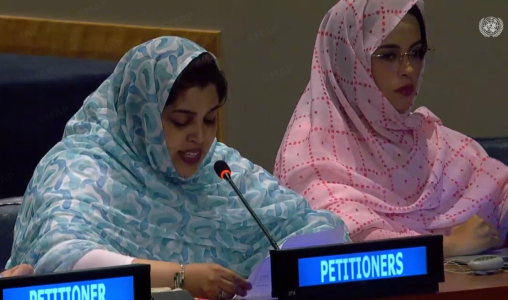
At the UN, elected representatives from the Moroccan Sahara highlight democratic growth and the dynamic development of the Southern Provinces
United Nations (New York) – Elected representatives from the Kingdom’s Southern Provinces addressed the Fourth Committee of the…

UN: Petitioners Denounce Recruitment of Children by “polisario,” Lack of Prospects in Tindouf Camps
United Nations (New York) – Several petitioners denounced at United Nations Headquarters in New York the recruitment and…
Morocco’s Parliament Set to Open With Socio-Economic Challenges High on Agenda
Rabat – Morocco’s Parliament will open the first session of the first year of its 12th legislative term…