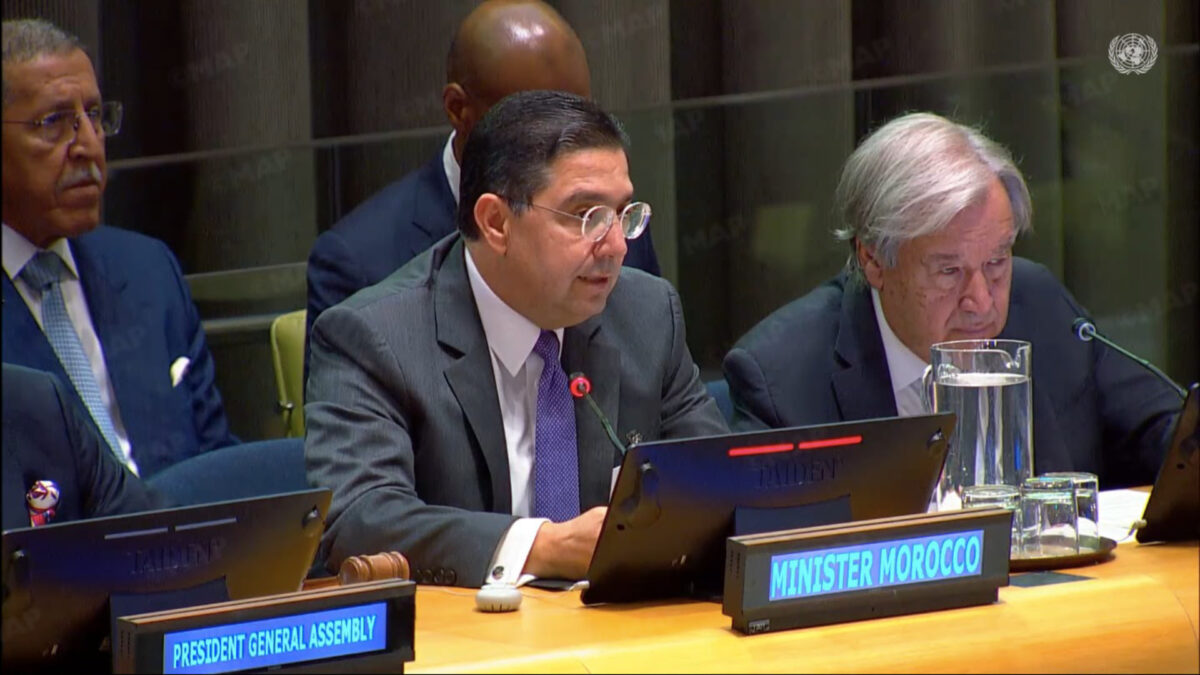
United Nations (New York) – The Minister of Foreign Affairs, African Cooperation and Moroccan Expatriates, Nasser Bourita, co-chaired the Global Conference on Promoting Interreligious and Intercultural Dialogue and Tolerance in Countering Hate Speech on Thursday at United Nations Headquarters in New York, on the sidelines of the 81st session of the UN General Assembly, alongside the UN Secretary-General and the President of the UN General Assembly.
Co-organized by Morocco, the United Nations Office on the Prevention of Genocide and the Responsibility to Protect, and the United Nations Alliance of Civilizations, this conference aims to strengthen the role of dialogue and tolerance in preventing hate speech and promoting social cohesion.
It reflects a commitment to continuing international efforts to combat hate speech, particularly through cooperation among governments, religious institutions, civil society, and digital sector stakeholders.
Speaking on the occasion, Bourita emphasized that Morocco’s initiative to organize this conference reflects the spirit of the message delivered by His Majesty King Mohammed VI to the participants at the 9th Global Forum of the United Nations Alliance of Civilizations, held in Fez on November 22, 2022, citing the passage in which His Majesty the King called for making politics, religion, and dialogue as means to serve peace.
Bourita emphasized that the recurring debate on hate speech in international forums should not be a temporary exercise, noting that manifestations of this hatred serve as a constant reminder of the urgent need for collective action to preserve human dignity and protect societies from rejection and division.
The minister noted that ignorance of others, the perpetuation of prejudices, and social and economic vulnerabilities can fuel fears that lead people to perceive religious and cultural diversity as a threat. These fears can be exploited politically by extremist groups to stir up discord and hold an entire community responsible for the actions of individuals.
In this regard, Bourita sounded the alarm about the normalization of hate by political leaders who have held government positions. He emphasized the need to draw attention to such stances, which contribute to making hate speech acceptable in public discourse.
The minister also emphasized the responsibility of political, religious, and intellectual leaders and institutions in combating the exploitation of religion and identity to justify exclusion, particularly when intolerance is presented under the guise of patriotism.
Regarding Morocco’s initiative to organize this conference, the minister emphasized that it stems naturally from the Kingdom’s commitment to dialogue, tolerance, and coexistence, and is part of a commitment deeply rooted in the Kingdom’s history, its institutions, and its policies.
He recalled that the Constitution enshrines a unified and pluralistic national identity, open to universal values, where the Arab-Islamic, Amazigh, and Saharo-Hassani components converge, and which is enriched by its African, Andalusian, Hebrew, and Mediterranean influences.
Bourita highlighted the central role of the Imarat Al Mouminine Institution, the cornerstone of this structure, noting that His Majesty King Mohammed VI, Amir Al Mouminine, is the guarantor of the free exercise of religious worship, in accordance with the Constitution. He emphasized that, under the auspices of this historically rooted institution, Morocco has, at various times, welcomed religious and ethnic communities forced to leave their countries to escape persecution and the Inquisition.
The minister noted that the deep-rooted tradition of coexistence among Morocco’s various religious communities — where Muslims, Jews, and Christians have shared the same space over the centuries — has resulted in an institutional commitment that is reflected in state policies under the leadership of His Majesty King Mohammed VI.
On the multilateral front, the minister noted that, under the auspices of this same institution and in line with this national framework, the Kingdom plays a leading role in combating hate speech in international forums. He cited the three resolutions adopted at Morocco’s initiative by the United Nations General Assembly, including the one on promoting interreligious and intercultural dialogue and tolerance in the fight against hate speech.
In addition, the minister identified five priorities to guide collective action: education on respect for diversity, embedding interreligious and intercultural dialogue in social life, promoting responsible public discourse, advancing equity and equal opportunity, and preventing hate speech in the digital sphere.
Bourita concluded by reaffirming the Kingdom’s determination to continue contributing to this effort, emphasizing that the protection of human dignity is a cornerstone of security and that coexistence requires ongoing commitment and shared responsibility.
Related articles
Before UN Security Council, Morocco Reaffirms Absolute Solidarity with Saudi Arabia Following “Cowardly” Houthi Attacks
United Nations (New York) – The Kingdom of Morocco reaffirmed, on Thursday during a UN Security Council arria…
His Majesty the King’s Leadership “Leads the Way” in the Fight Against Hate Speech (Moratinos)
United Nations (New York) – The leadership of His Majesty King Mohammed VI is leading the way for…
New York: Morocco Stresses that Management of Straits is a Responsibility, Not Ownership, Calls for Code of Conduct for Littoral States
New York – Morocco’s Minister of Foreign Affairs, African Cooperation and Moroccan Expatriates, Nasser Bourita, stated on Thursday…