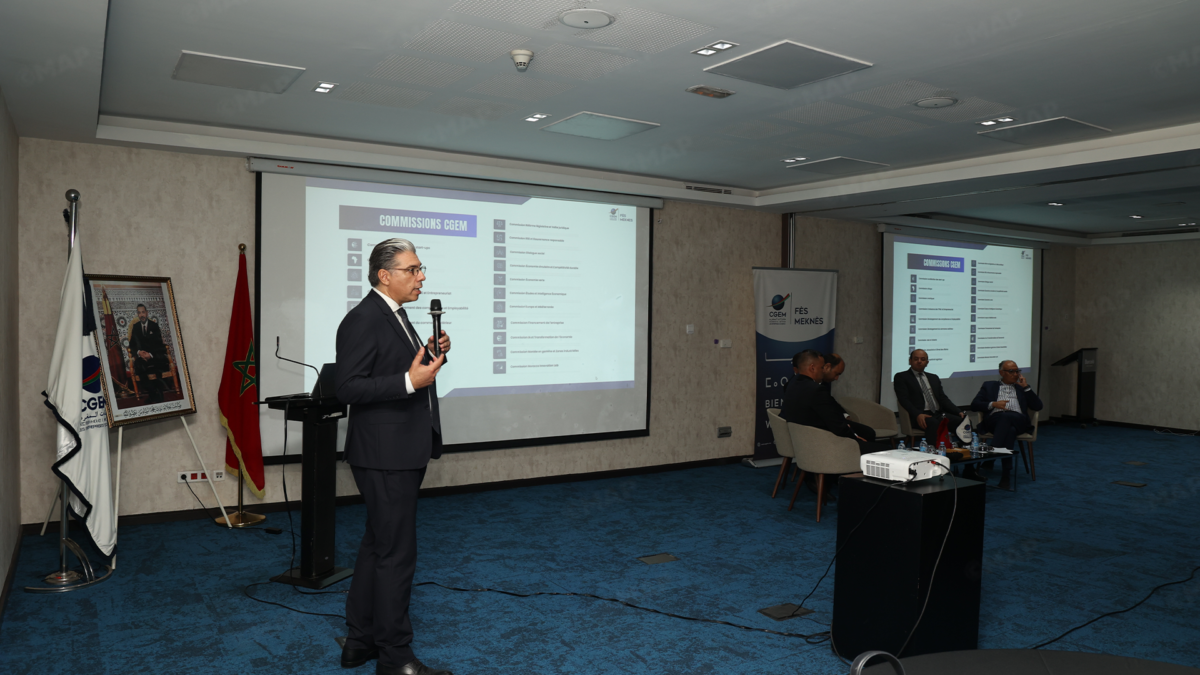
Strengthening private investment, consolidating the regional industrial fabric, and improving business competitiveness are at the heart of the new roadmap of the General Confederation of Moroccan Enterprises (CGEM) Fes-Meknes, presented Wednesday at its ordinary general assembly, which also reviewed the organization’s activity report.
Speaking at the event, the president of CGEM Fes-Meknes, Omar Tajmouati, highlighted the major economic transformations the Kingdom has undergone over the past two decades, notably the development of transport infrastructure and the expansion of the national industrial base.
He emphasized that the employers’ association’s actions are aligned with the national objective of increasing private investment to two-thirds of total investment by 2030, with the aim of transforming an economic model that still relies heavily on public investment.
In this regard, Mr. Tajmouati presented the main points of the CGEM’s national action plan, structured around 16 measures across five areas of intervention. At the regional level, this roadmap notably includes strengthening local integration in production chains, accelerating industrial decarbonization, improving access to medium-voltage electricity to reduce energy costs, and integrating artificial intelligence into small and medium-sized enterprises (SMEs).
The president of the CGEM Fes-Meknes branch also mentioned the establishment of technical links between the future national innovation laboratory and regional technological infrastructure, particularly the Fes Smart Factory, to foster synergies in research, innovation, and technology transfer.
For his part, the regional branch’s vice-president, Hamza Benabdellah, presented a review of the organization’s achievements, highlighting the main actions undertaken during the past period.
He specifically mentioned the operationalization of the Fes dry port’s logistics, in coordination with the Customs and Indirect Taxes Administration and the National Railway Office (ONCF), as well as the organization of the regional leg of the PortNet caravan, dedicated to raising awareness of foreign trade procedures.
Mr. Benabdellah also announced the signing of an agreement between the CGEM (General Confederation of Moroccan Enterprises), the Euro-Mediterranean University of Fez, the Digital Development Agency, and the National Agency for the Promotion of Employment and Skills, aimed at supporting regional businesses in their transition to Industry 4.0.
The report presented also highlighted the organization of working meetings with economic delegations from Italy and China, presentations on the financing mechanisms of the Mohammed VI Investment Fund, and the deployment of an information caravan on the provisions of the Finance Law in several provinces of the region.
For his part, the Director General of the Fez-Meknes Regional Investment Center (CRI), Mohamed Sabri, outlined the initiatives undertaken to facilitate procedures for investors and improve support for project promoters.
He notably presented the “Mantouj Jihti” digital platform, designed to identify industrial inputs and promote local supply chains, thereby helping to reduce dependence on imports.
Mr. Sabri also highlighted the preliminary technical review process for investment applications, which assesses regulatory compliance and project feasibility before project developers incur costs related to studies.
In the same vein, he announced the development of a 100-hectare industrial expansion at the Agropolis Meknes site, as well as the upcoming launch of new office spaces within the Fes Shore business park.
The proceedings of this general assembly also included discussions on issues related to employment and skills development. Participants stressed in particular the need to adapt vocational training programs to the real needs of businesses and to evolve the regulatory framework for work, in order to better respond to changes in the job market and the competitiveness requirements of the regional economic fabric.
Related articles
Plenary Sessions on Friday, Saturday to Examine & Vote on 2027 Finance Bill
Rabat – The House of Representatives will hold plenary sessions on Friday and Saturday to examine and vote…
Morocco SME Agency Stops in Casablanca as Part of the “PACTE TPME in the Regions” Caravan
Casablanca – Morocco SME Agency organized a new leg of its “PACTE TPME in the Regions” tour in…
The Economic, Social and Environmental Council (CESE) is working towards a responsible digital transformation to improve the quality of its advisory output (Mr. Amara)
Rabat – The President of the Economic, Social and Environmental Council (CESE), Abdelkader Amara, affirmed on Tuesday in…