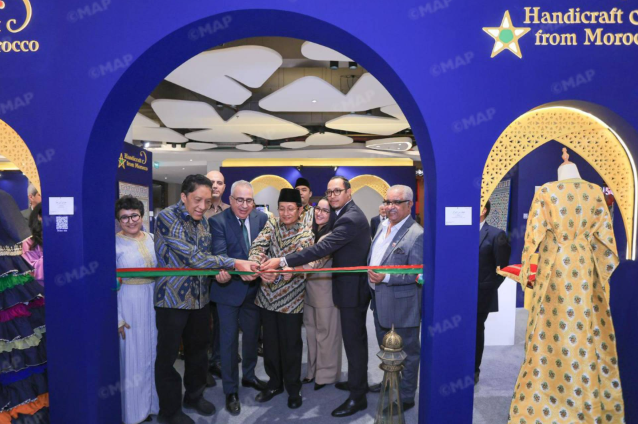
Jakarta – Moroccan colours, craftsmanship, fragrances and traditional arts took centre stage on Saturday in the Indonesian capital as the first edition of “Morocco Week in Indonesia” opened, showcasing the richness of the Kingdom’s heritage and seeking to give fresh impetus to cultural and economic exchanges between the two countries.
Jointly organised by the Embassy of the Kingdom in Indonesia and the Craftsman’s House, at one of Jakarta’s major shopping centres near the Indonesian Parliament, the Moroccan pavilion spans more than 200 square metres, bringing together Amazigh, Arab, African, Saharan and Mediterranean influences.
Handcrafted creations, works of art, finely worked materials and demonstrations of traditional crafts form an immersive experience, highlighting the richness of a heritage shaped by diverse influences and preserved through skills and techniques passed down from one generation to the next.
The opening ceremony, chaired by Morocco’s Ambassador to Indonesia, Redouane Houssaini, was attended, notably, by Indonesian Minister of Religious Affairs Nasaruddin Umar and Secretary-General of the Indonesian Ministry of Culture Bambang Wibawarta, alongside members of the diplomatic corps accredited in Jakarta, Indonesian officials, institutional representatives, journalists and partners of Morocco. Members of the Moroccan community living in Indonesia also attended the event.
Speaking on the occasion, Wibawarta welcomed the initiative as a means of consolidating the bonds of friendship between Morocco and Indonesia and bringing their peoples closer together. He highlighted the depth of bilateral relations, underpinned by historical ties and a shared determination to expand cooperation in the cultural, economic and institutional fields.
The Indonesian official also underscored the prominent role of culture and craftsmanship in fostering intercultural dialogue and mutual understanding. Discovering Morocco’s heritage and age-old skills, he noted, provides fertile ground for enriching exchanges between the two societies and exploring new avenues of cooperation.
For his part, Houssaini highlighted the symbolic significance of this inaugural edition, whose opening coincides with the celebration of Unity Day. Running until November 6, the event also takes place against the backdrop of the commemoration of the 51st anniversary of the Glorious Green March, giving it particular significance in Morocco’s national calendar.
The ambassador placed the initiative within the positive momentum of friendship and cooperation between Rabat and Jakarta, stressing its role in raising the Kingdom’s profile in Indonesia and, more broadly, across Southeast Asia.
He also noted that the event seeks to familiarise Indonesian audiences with the many facets of Moroccan heritage while highlighting the potential for closer ties between the two countries.
Throughout the week, visitors will be able to explore the various expressions of Moroccan craftsmanship through a selection of creations and demonstrations by artisans from the Kingdom.
These encounters with craftsmen will showcase the precision of their techniques, the richness of their skills and the transmission of traditional craftsmanship, while illustrating its ability to evolve through creativity and innovation.
The programme also places a special emphasis on Moroccan culinary traditions, with tastings introducing visitors to the country’s gastronomy, as well as on the elegance of the caftan, which will take centre stage in a dedicated fashion show.
Beyond this cultural showcase, Morocco Week aims to translate the momentum of closer bilateral ties into tangible economic opportunities. Business meetings are scheduled between representatives of the Craftsman’s House, the Indonesian Chamber of Commerce and Industry (KADIN), and the Association of Indonesian Handicraft Exporters and Producers (ASEPHI), organiser of the international handicrafts fair INACRAFT.
These B2B meetings seek to promote the exchange of expertise between Moroccan and Indonesian professionals, identify potential business partnerships and explore new markets for handicraft products from both countries. They reflect the ambition to extend the benefits of the event beyond its duration, turning heritage promotion into a driver of professional cooperation and trade development.
Southeast Asia’s largest economy, Indonesia, with a population of nearly 286 million, a gross domestic product exceeding 1.4 trillion dollars and economic growth of around 5% in 2025, represents a market with promising prospects for Moroccan businesses. Its large domestic market, expanding middle class and dynamic distribution networks offer significant opportunities for Moroccan handicrafts, particularly in the home décor, furnishings and lifestyle segments.
In Jakarta, this inaugural Morocco Week thus seeks to be far more than an exhibition of products and traditions. It aims to turn the encounter between two rich heritages and distinct craftsmanship traditions into a platform for deepening relations between Rabat and Jakarta and placing their growing ties on a lasting cultural and economic footing.
Related articles
Minurso Became a ‘Permanent Monument to Something that Could Not Work’ – U.S. Ambassador to the UN
United Nations (New York) – U.S. Ambassador to the United Nations Mike Waltz stated on Friday before the…
HRH Crown Prince Moulay El Hassan Launches Operations at First Container Terminal at Nador West Med Port
Iaazzanene Commune (Nador Province) – On High Instructions of His Majesty King Mohammed VI, may God assist Him,…

First Commemoration of Unity Day: Royal Pardon for 907 People
Rabat – On the occasion of the first commemoration of Unity Day, His Majesty King Mohammed VI, may…