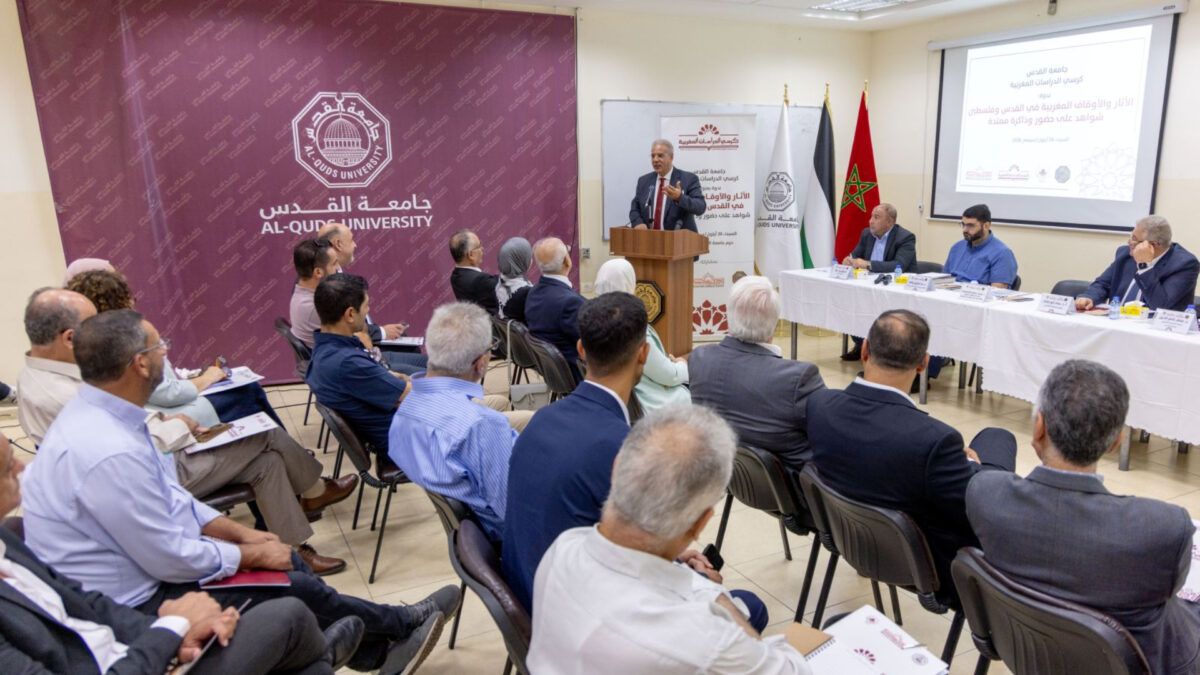
Al-Quds – The Chair of Moroccan Studies at Al-Quds University inaugurated the new academic year on Saturday by organizing a scientific symposium under the theme: “Moroccan Monuments and Waqf Properties in Al-Quds and Palestine: Testimonies of a Centuries-Old Presence and Memory.”
During this meeting, which was notably marked by the presence of Mohamed Salem Cherkaoui, Managing Director of the Bayt Mal Al-Quds Asharif Agency, and Imad Abu Kishek, President of Al-Quds University, participating researchers emphasized the importance of documenting the monuments and waqf properties associated with the Moroccan presence in Al-Quds and Palestine.
They also highlighted the need to shed light on the main testimonies of this presence and the sources available to document them, as well as the transformations they have undergone, while exploring ways to preserve this historical heritage and transmit it to future generations.
Discussions focused on the significance of documents, waqf deeds, registers, photographs, maps, and accounts related to Moroccan monuments and waqf properties, as well as the challenges involved in documenting sites that have undergone transformations or disappeared.
In this context, participants examined the opportunities offered by archiving tools, digitization, and modern technologies to preserve physical and documentary memory, calling for stronger cooperation among academic, cultural, and archival institutions.
Furthermore, they advocated for the development of specialized scientific projects focused on inventorying, documenting, and studying Moroccan monuments and waqf properties in Al-Quds and Palestine, shifting from scattered research initiatives toward structured projects that bring together the study of monuments, waqfs, documents, and memory.
On this occasion, Cherkaoui noted that the interest given to scientific and cultural research related to Al-Quds aligns with the constant High Concern that His Majesty King Mohammed VI, Chairman of the Al-Quds Committee, bestows upon the Holy City and its inhabitants, reflecting the Sovereign’s keenness to safeguard its civilizational identity and preserve its memory.
He added that the unique nature of the Chair of Moroccan Studies lies in its location within the city of Al-Quds itself. This grants it a privileged scientific standing to work on issues related to Al-Quds and Palestine, while expanding into the study of the Moroccan presence in the Levant and the historical and civilizational ties with the region.
Cherkaoui also expressed his hope to see the Chair continue developing its role as a hub for knowledge production and documentation of Moroccan memory in Al-Quds, Palestine, and the Levant, and to see the partnership between the Agency and the University expand to scientific, educational, and cultural projects serving Al-Quds and its people.
For her part, Safaa Nassereddine, Head of the Chair of Moroccan Studies at Al-Quds University, stated that this symposium is part of the Chair’s commitment to documenting the Moroccan presence in Al-Quds and Palestine, transitioning from scattered knowledge toward structured, scientifically documented expertise.
She noted that this approach paves the way for future research projects in inventorying, documentation, archiving, and digitization, adding that preserving memory is not limited to safeguarding monuments alone, but also encompasses generating knowledge about them and making it available to researchers and future generations.
She argued that Moroccan monuments and waqf properties in Al-Quds and Palestine are not merely buildings or assets of historical value, but serve as tangible and documentary evidence of a long-standing, continuous Moroccan presence, as well as its associated roles in the religious, social, cultural, and educational life of the Holy City.
For his part, Imad Abu Kishek, President of Al-Quds University, stressed the importance of this symposium in highlighting the historic Moroccan presence in Al-Quds and Palestine, as well as strengthening the role of scientific research in documenting and preserving this civilizational heritage.
He explained that organizing this meeting demonstrates the importance of the partnership and cooperation between Al-Quds University and the Bayt Mal Al-Quds Asharif Agency, along with their shared goal of supporting the Holy City and enhancing its role in scientific research and cultural fields.
Abu Kishek also commended the efforts of the Chair of Moroccan Studies in organizing scientific events that help deepen understanding of the Moroccan presence in Al-Quds, reaffirming the University’s commitment to supporting academic initiatives that serve the city and preserve its memory.
The Chair of Moroccan Studies at Al-Quds University was established on March 2, 2025, through an initiative by the Bayt Mal Al-Quds Asharif Agency, in cooperation with the University and the Moroccan Cultural Center Association (Bayt Al-Maghrib).
It is dedicated to studying and documenting the historical, cultural, and human relations between Morocco, Al-Quds, and Palestine, and transforming this shared heritage into a structured field of research, teaching, and knowledge production.
Related articles
Moroccan people celebrate HRH Princess Lalla Asmaa’s birthday on Tuesday
Rabat – The Royal Family, and with them the Moroccan people, celebrate HRH Princess Lalla Asmaa’s birthday on…
The Ministry of the Interior has dispatched a central inspection commission to Tangier to investigate irregularities that marred the electoral process at two polling stations.
Rabat – The Ministry of the Interior has dispatched a central inspection commission to the city of Tangier…

Monday Weather Forecast
Rabat – Here is the weather forecast issued by the General Directorate of Meteorology for Monday, September 28,…