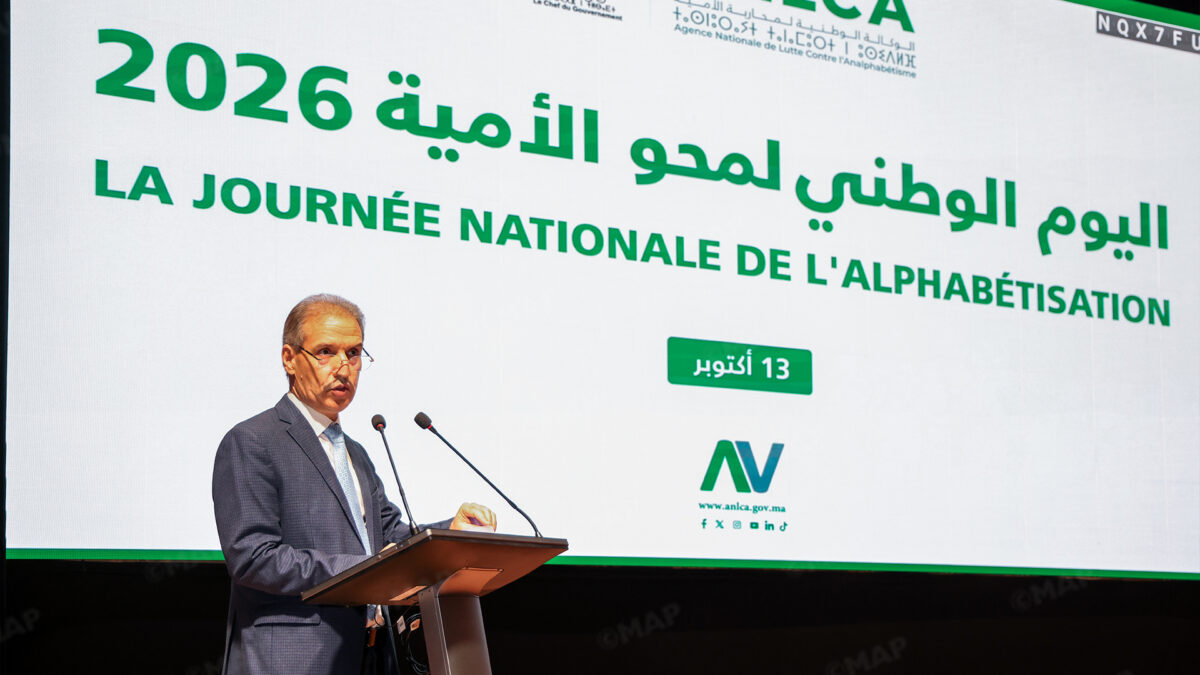
Rabat – The National Agency for the Fight Against Illiteracy (ANLCA) is dedicating a strategic focus to developing more effective programs with a concrete impact, through strengthening targeting mechanisms, on-the-ground monitoring, and objective evaluation, the Agency’s director, Abdelouadoud Kharbouch, stated yesterday in Rabat.
Beyond simply expanding the range of services offered, the evolution of literacy programs requires an approach based on precise targeting, quality management, regular monitoring, and objective evaluation, Mr. Kharbouch noted at the opening of National Literacy Day 2026.
Such an approach will make it possible to achieve measurable results and generate a tangible impact for the benefit of those concerned, he added during this meeting, which was held under the theme “From Local Proximity to Concrete Impact: Strengthening Targeting, Monitoring, and Evaluation for Effective and High-Performing Literacy Programs.”
These guidelines are part of the ongoing implementation of the National Literacy Strategy 2023-2035 and the rollout of the Roadmap 2023-2027, structured around four complementary pillars: targeting, convergence, quality, and governance, explained the director of the National Agency for the Fight Against Illiteracy (ANLCA).
He further stated that the launch of precise and inclusive targeting, based on data from the Unified Social Registry, represents a significant step towards a more refined identification of target populations and a more tailored approach to interventions that better reflect their needs and their specific social and territorial characteristics. He noted that this approach contributes to promoting equitable access to programs.
Mr. Kharbouch also emphasized the importance of reliable data and digital transformation in improving management and developing steering and decision-making mechanisms, highlighting the role of the integrated management system for literacy programs, which enables the digitization of program management processes.
For his part, the director of the regional office of the United Nations Educational, Scientific and Cultural Organization (UNESCO), Charaf Ahmimed, stressed that literacy represents the fundamental basis of social justice and equal opportunities, empowering the population, and especially women, to be fully engaged participants in the dynamics of economic and social development.
Commending Morocco’s efforts to develop an inclusive education system that meets the aspirations of diverse groups, Mr. Ahmimed praised the pioneering role of the National Agency for the Fight Against Illiteracy (ANLCA) and all partners and stakeholders on the ground. He reiterated UNESCO’s commitment to supporting the Kingdom through accelerating the digital transformation of learning mechanisms, developing distance learning programs, and strengthening national capacities and skills.
For his part, the Director of Social Action and Reintegration at the General Delegation for Prison Administration and Reintegration (DGAPR), Benaïssa Bennasser, reviewed the various initiatives undertaken for the benefit of inmates in prison facilities. He noted that the efforts made over the past decade have enabled beneficiaries to acquire the necessary basic skills and overcome the challenge of illiteracy, resulting in increased participation in rehabilitation and training programs.
This meeting, which brought together representatives from governing bodies, ministerial departments, and public institutions, as well as partner international organizations and bodies, was highlighted by the ceremony for the 2nd National Literacy Prize. This prize recognizes the initiatives and exemplary practices of associations, trainers, and beneficiaries who have achieved remarkable progress in continuing their studies, creating income-generating projects, or acquiring skills.
The prize celebrates a culture of excellence, values best practices, and contributes to strengthening the quality and effectiveness of literacy programs, while encouraging continued learning and the economic and social inclusion of beneficiaries.