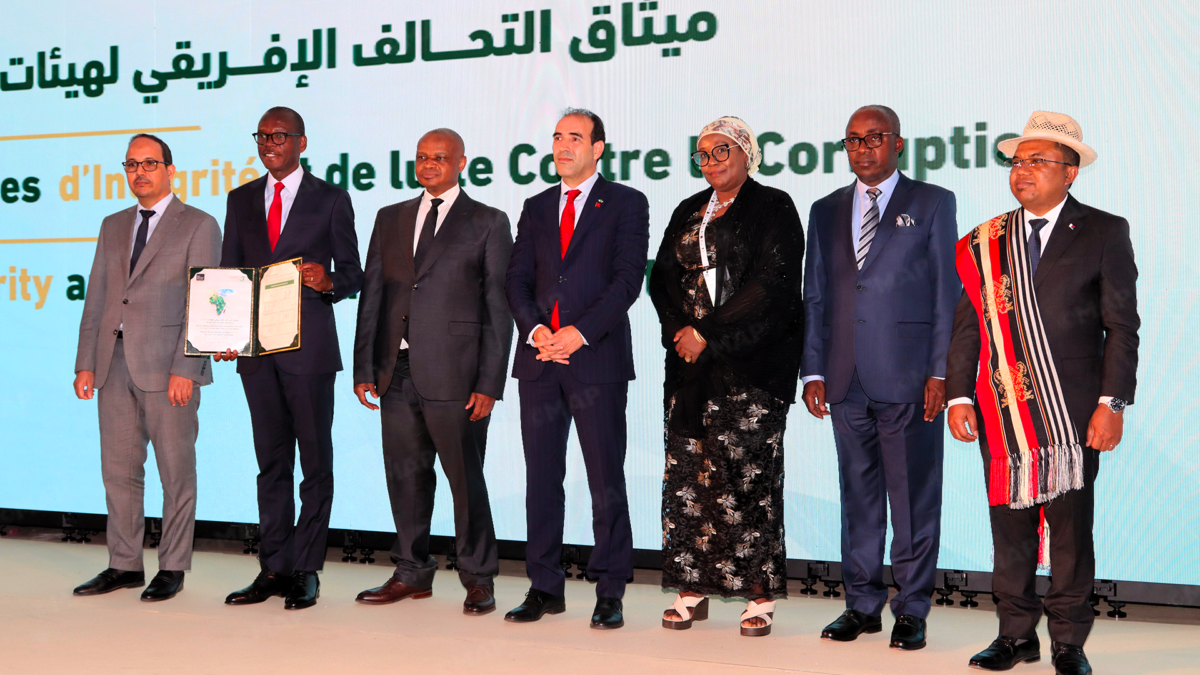
Marrakech – The African Alliance of Open Institutions for Integrity and the Fight Against Corruption was launched Monday in Marrakech at the closing ceremony of a meeting that brought together the heads of African bodies and commissions dedicated to integrity and the fight against corruption.
This new organization, whose headquarters and permanent secretariat will be located in Morocco, within the National Authority for Probity, Prevention and the Fight Against Corruption (INPPLC), aims to strengthen the effectiveness of corruption prevention and control through the exchange of experiences and best practices, capacity building, and the mobilization of institutional openness tools, including transparency, open data, and participation.
This Alliance also aims to encourage joint or integrated initiatives and commitments in areas of common interest, to support capacity building and the development of African knowledge and expertise in fields related to the work of this structure, and to strengthen cooperation with relevant regional and international partners, particularly with the Secretariat of the Open Government Partnership (OGP) Initiative.
The adoption of periodic work programs allows these priorities to be translated into joint initiatives that benefit from the accumulated expertise of African institutions, within a framework that respects the independence and competences of each institution.
The ten founding institutions of the Alliance come from nine African countries: Gabon, South Africa, Mauritania, the Union of the Comoros, Madagascar, the Central African Republic, the Republic of the Congo, Côte d’Ivoire, and Morocco.
On this occasion, the ten African institutions adopted the Alliance Charter, thereby announcing, in their capacity as founding institutions, the launch of a permanent African framework for cooperation among integrity and anti-corruption institutions.
They also drafted the Alliance’s Preliminary Roadmap for 2027.
Speaking at the event, the President of the INPPLC, Mohamed Benalilou, emphasized that this initiative was based on the principle of complementarity, not competition, with other associations and bodies working in the field of anti-corruption. He asserted that no institution, association, or state can combat this phenomenon alone, given its complexity and multiple dimensions, hence the need for joint and coordinated action.
He clarified that the Charter was not an international convention, but a declaratory pact of intent aimed at establishing a framework for cooperation based on the principles of open government, from the perspective of open institutions. It emphasized respect for the legal, constitutional, organizational, geographical, cultural, and environmental specificities of each country, while preserving the independence of institutions and their regulatory frameworks.
Highlighting the importance of cooperation, the sharing of experiences and best practices, and mutual support between the various African and international bodies, in order to strengthen openness to civil society and contribute collectively to the fight against corruption, Mr. Benalilou indicated that this Charter was an initiative open to the accession of other competent African bodies and institutions in matters of integrity and the fight against corruption.
He further noted that this openness allows the signatory institutions to contribute, alongside the ten founding institutions, to defining cooperation priorities and developing initiatives that address their common needs.
It should be recalled that the General Secretariat of the Alliance is responsible for supporting coordination between member institutions and for assisting in the implementation of joint work programs, while the Alliance’s meetings and the organization of its activities can be held in the various African countries to which the member institutions belong.
Related articles
UN: Morocco’s Biennial Resolution on Sustainable Tourism Adopted by Consensus
United Nations (New York) – The Second Committee of the United Nations General Assembly adopted on Monday, by…
Morocco, Madagascar Seal 9 Agreements to Give New Impetus to Sectoral Cooperation
Rabat – The Minister of Foreign Affairs, African Cooperation and Moroccan Expatriates, Nasser Bourita, received on Monday in…
Mauritanian Government Seeks to Boost Trade with Morocco, Spur Investment -Minister
Nouakchott – The Mauritanian government is working to strengthen trade exchanges with Morocco, encourage joint investments and expand…