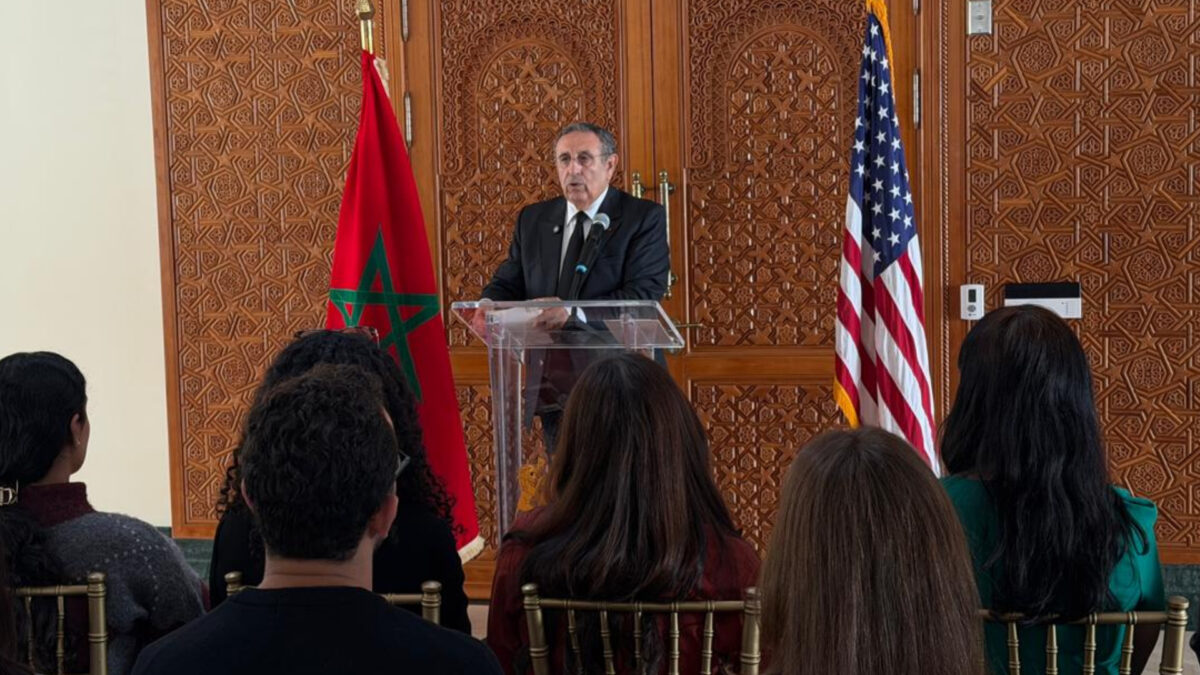
The latest developments in the Western Sahara issue, in light of recent developments at the UN Security Council, were the subject of an in-depth discussion on Wednesday in Washington between Morocco’s Ambassador to the United States, Youssef Amrani, and academics from three prestigious institutions in the American capital (Georgetown, Johns Hopkins, and American University).
Both retrospective and prospective, this exchange allowed for an in-depth analysis of the diplomatic shifts surrounding the Western Sahara issue, while also highlighting the foundations and prospects of the Moroccan-American strategic partnership, as well as the major structural projects shaping the Morocco of tomorrow.
Regarding the Moroccan Sahara, Mr. Amrani emphasized that “while the Russian veto prevented the adoption of the draft resolution introduced by the American penholder and led to the non-renewal of MINURSO’s mandate, the momentum toward resolving this regional dispute continues, respecting the Kingdom’s sovereignty and territorial integrity.”
For the Moroccan diplomat, this step marks “the closing of a 35-year chapter, reflecting the exhaustion of a framework that has become ill-suited to current political and diplomatic realities, while also paving the way for significant progress in addressing the issue.”
Mr. Amrani observed that the support expressed by eleven members of the Security Council for the American draft resolution, combined with the support of more than two-thirds of the United Nations member states for autonomy under Moroccan sovereignty, “demonstrates a growing international convergence around a fundamental principle: autonomy under Moroccan sovereignty constitutes the most feasible solution to this dispute, and explicitly confirms that the Moroccan Autonomy Initiative must serve as the sole basis for any further negotiations.”
In this context, he emphasized that “the veto cannot erase the diplomatic progress achieved, nor call into question the political significance of the principles enshrined by the Security Council in its resolution 2797 and even more so in the draft resolution presented this year.”
“Under the leadership of His Majesty King Mohammed VI, Morocco is approaching this new phase with serenity and determination, strengthened by the strategic guidelines outlined in the Royal Cabinet communiqué of October 30 and the working session chaired by the Sovereign on November 4,” he continued.
“This new phase is consistent with the Royal Directives aimed at preserving the Kingdom’s territorial integrity, guaranteeing security, and pursuing the major structural development projects in our southern provinces,” the ambassador affirmed.
The Moroccan diplomat also emphasized that “the end of MINURSO in no way signifies the end of the Kingdom’s commitment to peace and maintaining the ceasefire, to which we remain firmly and responsibly attached.”
Addressing the humanitarian dimension, the ambassador noted that the American draft resolution also had the merit of “placing at the heart of international concerns the deeply worrying situation prevailing in the Tindouf camps, marked by prolonged displacement and a continuous deterioration of humanitarian conditions, which it is neither reasonable nor responsible to allow to continue.”
He concluded that “human dignity cannot remain hostage to the political ambitions of certain well-known parties, and that the search for a definitive settlement must imperatively be accompanied by concrete prospects enabling these populations to emerge from decades of precariousness and uncertainty.”
Beyond the issue of the Moroccan Sahara, this meeting also provided an opportunity to highlight the historical depth and strategic significance of the Moroccan-American alliance, which is poised to reach new heights.
The long-standing relationship between Morocco and the United States has weathered regional and international shifts to become a true alliance, the ambassador noted, attributing this evolution to the leadership of His Majesty King Mohammed VI and President Donald Trump.
“This alliance is built on a foundation of shared values, interests, and visions,” he asserted.
Furthermore, Mr. Amrani emphasized the relevance of the “Morocco Offer” and the roadmap dedicated to developing the national defense and security industry. This offer, he explained, is part of the ongoing strategic development of the United States.
Related articles
World Conference on Air Transport : Kayouh Holds Series of Bilateral Meetings
Montreal – Minister of Transport and Logistics, Abdessamad Kayouh, held a series of bilateral meetings in Montreal focused…
El Mansouri Represents HM the King at 20th Francophonie Summit
Phnom Penh – Head of Government Fatima Ezzahra El Mansouri is representing His Majesty King Mohammed VI at…
The Bayt Mal Al-Quds Acharif Agency Distributes Medication to Beneficiaries of its Free Medical Campaigns
The Bayt Mal Al-Quds Acharif Agency, under the auspices of the Al-Quds Committee chaired by His Majesty King…