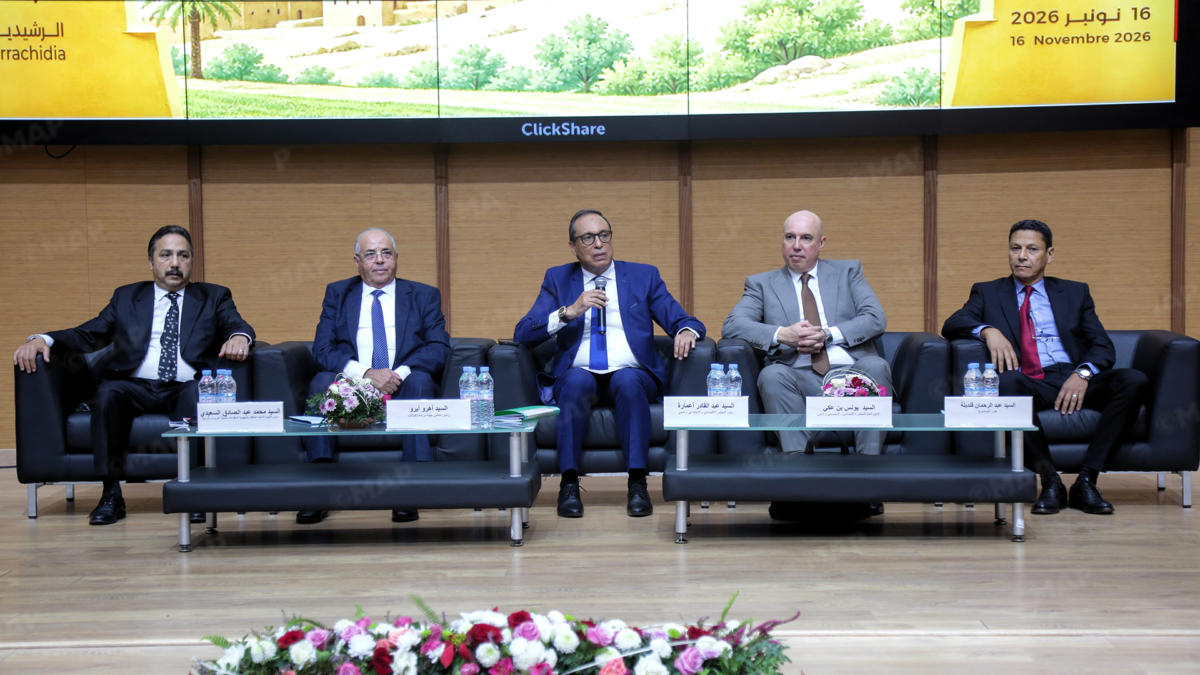
Errachidia – The Economic, Social and Environmental Council (CESE) held a workshop in Errachidia on Monday to present the main points of its report entitled “What role should villages play in rural development?”
This meeting provided an opportunity to share the key findings of the assessment with local stakeholders and other relevant parties, as well as the recommendations formulated by the CESE to strengthen the role of villages in rural development policies and enhance their contribution to regional development.
The choice of Errachidia to host this workshop reflects the CESE’s commitment to engaging with local communities and strengthening dialogue with local stakeholders. It is particularly significant given the unique natural, economic, social, and cultural heritage characteristics of the province and, more broadly, the Drâa-Tafilalet region.
Indeed, the province of Errachidia was among the territories visited by the Council during the preparation of this opinion.
Speaking at the opening of this event, the President of the Economic, Social and Environmental Council (CESE), Abdelkader Amara, emphasized the unique role of the douar (village) in the rural world, noting that beyond its residential function, the douar constitutes a space for living, solidarity, and community organization, as well as a place for production, the transmission of know-how, and the preservation of cultural heritage.
The President of the Council also highlighted the progress made in recent decades thanks to successive rural development programs, particularly in terms of infrastructure, opening up access to isolated areas, and improving the living conditions of the population.
He noted, however, that this progress has not translated everywhere into effective and equitable access to essential services. Significant disparities still persist between villages, particularly in isolated or scattered villages, where remoteness and accessibility constraints make access to basic services even more difficult.
Beyond these constraints, the Council President highlighted three structural limitations that reduce the scope of development efforts: the still insufficient consideration given to the village in territorial planning and programming, the lack of detailed data on its socio-economic realities, needs, and potential, and the predominance of an approach focused on the construction of infrastructure rather than on effective access to services.
In this regard, Mr. Amara emphasized the importance of establishing the village as the basic unit of rural development, making it a benchmark for identifying needs, leveraging local potential, and defining development priorities. He stated that the aim is to establish the douar (village) as the starting point for better planning rural development, while ensuring its integration with the municipality and other levels of territorial organization.
For his part, Council member and rapporteur for this topic, Abderrahmane Kandila, presented the main recommendations of the opinion. These recommendations include the CESE’s call for the development of collaborative douar development plans (PCDDs), based on the socio-economic needs of the population, local potential, and demographic trends; strengthening knowledge of the realities and transformations of douars; and adapting urban planning documents, development regulations, and building standards to the specific characteristics of douars, taking into account housing types, demographic changes, agricultural and livestock activities, and territorial constraints.
This also involves the need to strengthen access to essential services, mobility, and connectivity by consolidating inter-municipal cooperation to pool resources and develop services tailored to the needs of the villages, leveraging the economic potential of the villages, creating jobs and generating income, preserving and promoting the collective memory and intangible heritage of the villages, preserving natural resources, and strengthening the environmental resilience of the villages.
This meeting was enriched by the constructive contributions of representatives from institutions, local authorities, and civil society, focusing on the levers and prospects for village development.
Related articles
Fahs-Anjra: Raising Parental Awareness of Supporting Children with Disabilities
Anjra Municipality – A training and awareness workshop was held on Monday at the Khmis Anjra Center for…
Al Akhawayn University Trains 343 Young People for Future-Oriented Careers and Wins First Place in the A-IDI Program
Ifrane – Al Akhawayn University in Ifrane (AUI) trained 343 young Moroccans for future-oriented careers between January 2025…
International Human Rights Activists Issue in Essaouira International Call for Peace
Essaouira – Human rights activists from several countries, gathered for the 3rd World Forum of Women for Peace,…