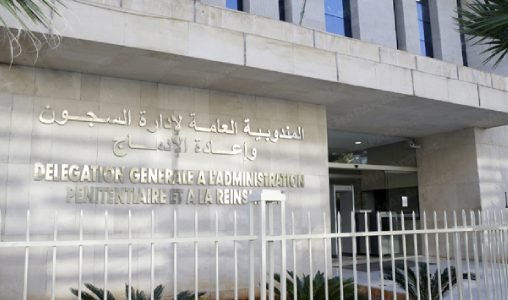
Rabat – Individuals incarcerated in connection with the Gdeim Izik events are being held under “normal” conditions and are receiving the necessary health care, stated the General Administration for Prison Administration and Reintegration (DGAPR) in a clarifying statement on Tuesday.
This clarification comes in response to a statement published on October 12 by the International Federation for Human Rights (FIDH) and the World Organisation Against Torture (OMCT) regarding what the two organizations present as an “open hunger strike undertaken by eight inmates incarcerated in connection with the Gdeim Izik events,” as well as allegations concerning “their detention conditions, their state of health, and their demand regarding their transfer.”
In this regard, the DGAPR regrets that the two organizations ignored the clarifications it had previously provided in its statements dated September 24 and October 6, 2026, respectively, regarding the situation of the inmates concerned.
In fact, the two organizations relied exclusively on false data relayed on this subject by certain newspapers and websites aligned with positions hostile to the territorial integrity of the Kingdom.
The General Administration reminds the two organizations that only five inmates are currently observing a hunger strike, not eight, noting that on September 23, 2026, six inmates belonging to this group, five incarcerated at the Kenitra central prison and one at the Tiflet 2 local prison, notified the administrations of the prison facilities concerned of their intent to go on a hunger strike.
On September 30, 2026, inmate (N. A) ended his hunger strike. As for the other inmates in this group incarcerated in various prison facilities, they are not on any hunger strike and are taking their daily meals under normal conditions, the same source added.
The inmates were cared for in accordance with the protocol in force and placed under continuous medical supervision, while also benefiting from institutional visits provided for by law.
Regarding the requests to transfer the inmates concerned to prison facilities located in the Southern Provinces of the Kingdom, inmate (B. K) was transferred on September 23, 2026, from the Tiflet 2 local prison to the Laayoune local prison because he met the required criteria for transfer to the requested facility, as his remaining prison sentence did not exceed four years, noting that he was not observing a hunger strike.
On the same date, inmate (N. A) was transferred, at his request, to the Al-Oudaya local prison in Marrakech. As for inmate (H. D), he was transferred to the Ben Guerir local prison on disciplinary grounds following a serious infraction committed within the prison facility where he was incarcerated.
Upon their transfer, the inmates concerned were allowed to contact their families to inform them of their place of detention, in accordance with the legal provisions governing prison facilities. They also received visits from their relatives.
In this regard, the DGAPR emphasizes that responsible organizations working in the field of defending and promoting human rights are called upon to demonstrate objectivity in the reports and statements they publish and to conduct the necessary verifications, rather than relying exclusively on specific sources that seek to mislead public opinion for suspicious ends by spreading erroneous information.
Related articles

His Majesty King Mohammed VI Receives Appointed Head of Government Fatima Ezzahra El Mansouri
“His Majesty King Mohammed VI, may God assist him, received on Wednesday, October 14, 2026, at the Royal…

Morocco in Advanced Talks to Acquire Israeli LORA Ballistic Missiles
RABAT — Morocco is reportedly in advanced negotiations with Israel Aerospace Industries (IAI) to purchase the LORA long-range…
Four Parties to Make up Morocco’s New Government Majority
Rabat – Morocco announced Monday a four-party majority government comprising the Authenticity and Modernity Party (PAM), the Istiqlal…