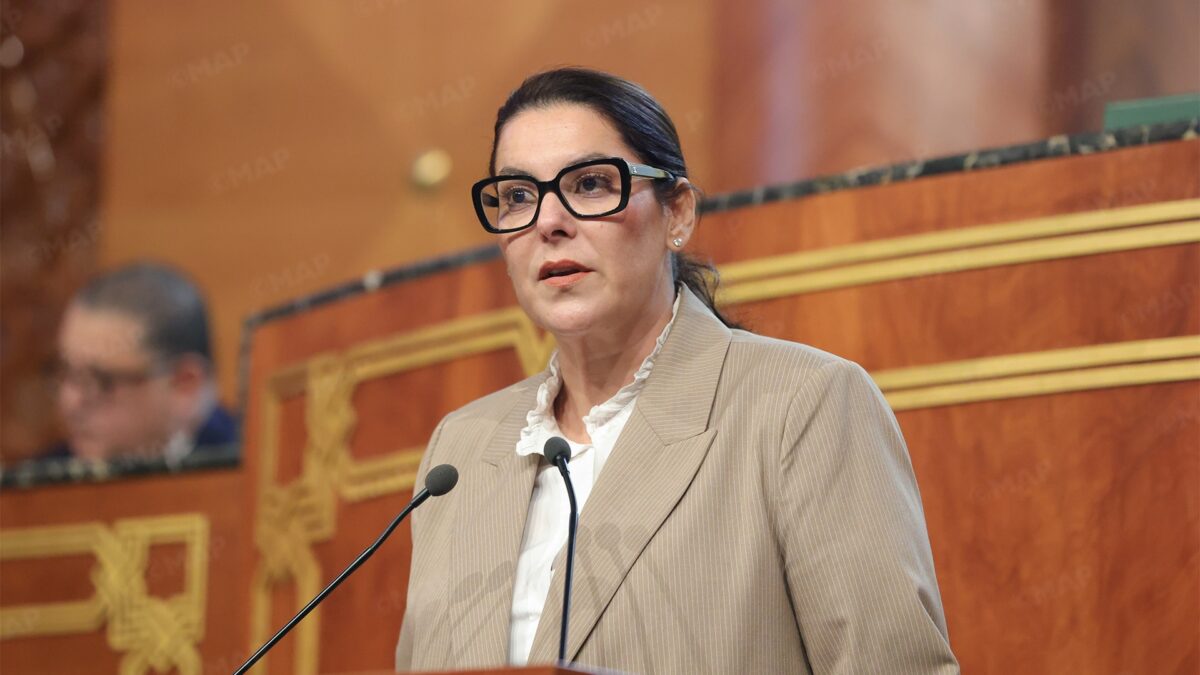
Rabat – The government will adopt concrete, effective, and realistic measures, backed by figures and real funding to implement its program, emphasized on Wednesday in Rabat the Head of Government, Fatima Ezzahra El Mansouri.
In response to interventions by groups and parliamentary groupings during a plenary session dedicated to discussing the government program in the House of Councillors, El Mansouri said that the government’s commitments are not limited to “simple declarations of intent,” but are based on measures developed after listening to citizens and exchanging with them at the local level, particularly regarding the future of the youth, the situation of the elderly and women, as well as purchasing power.
Regarding remarks on the level of ambition of these commitments, she said that Morocco has human and natural resources, solid institutions, stability, and infrastructure enabling it to achieve great ambitions, expressing confidence in the government’s ability to reach the set objectives.
She also highlighted the political nature of her government, the result of a shared vision between four national political parties that share close democratic values and references, and which are committed to dialogue, proximity to citizens, and listening to their expectations.
In this sense, the Head of Government assured that the moralization of public life and political practice is the way to restore citizens’ trust in institutions, particularly elected ones, noting that integrity “is not a simple slogan, but a necessity for society,” and that the majority parties have agreed to fight against conflicts of interest as soon as possible.
On the socio-economic front, El Mansouri specified that purchasing power is affected by geopolitical shifts, but it also depends on national management, which can be improved, insisting that “the government refuses to let certain categories enrich themselves at the expense of others.”
Similarly, she emphasized that the government supports investment, encourages businesses, simplifies administrative procedures, and plans to replace authorizations with specifications, given the role of businesses in job creation, development, and the strengthening of stability.
Regarding employment, El Mansouri reaffirmed the ambition to create one million jobs, reduce the unemployment rate to 7%, and increase women’s employability to 21.2% by 2031.
As for social dialogue, she stressed that the government will continue this dialogue with unions and social partners and will ensure that commitments made are respected, noting the allocation of 50 billion dirhams for this purpose for the year 2027.
In the same vein, she affirmed the continuation of the Royal project of social protection, which goes beyond political timeframes and is part of the structural projects linked to the Kingdom’s national strategy.
Furthermore, the Head of Government observed that development management in rural areas will rely on the convergence and involvement of various stakeholders at the local level, namely the walis, governors, and presidents of communes and regions, pointing out that listening to citizens’ needs must begin on the ground, with the government responsible for developing the political vision while execution will take place at the territorial level.
As for expatriates, El Mansouri emphasized that they represent partners in the Kingdom’s development dynamics, conveying the Executive’s determination to operationalize the Mohammedia Foundation for Moroccans of the World as soon as possible.
Similarly, she highlighted the importance of digitalization to bring services closer to Moroccans around the world, including consular services and those of other concerned institutions.
Presenting the financial data related to government commitments, El Mansouri noted that total expenditures are expected to reach 390 billion dirhams, of which 314 billion dirhams will be covered by the general state budget, while the remaining 76 billion dirhams will come from non-budgetary resources.
Among these expenditures, 108 billion dirhams will be dedicated to social protection, 93 billion dirhams to supporting purchasing power, 57 billion dirhams to the integrated territorial development program, 30 billion dirhams to youth integration, and 26 billion dirhams to infrastructure development, she specified.
El Mansouri also emphasized that the government is targeting an economic growth of 5%, a deficit contained at 3%, and inflation of 2%, while ensuring that debt does not exceed 62% by 2031. In this regard, she mentioned the mobilization of approximately 240 billion dirhams in additional tax resources, relying on economic growth and the expected increase in tax and customs revenues.
Related articles
Omar Hilale: “Morocco, a Bridge Between UN, AU for African-led Peace”
United Nations (New York) – Ambassador and Permanent Representative of Morocco to the United Nations, Omar Hilale, co-chaired…
House of Councillors: Majority Defends Government Program Priorities
The majority groups in the House of Councillors welcomed the government program’s guidelines on Wednesday, while calling for…
Morocco’s Autonomy Plan Takes Center Stage in Negotiations (Mohammed Loulichki)
The debate is no longer solely about the outcome of the dispute, but about how to resolve it.…