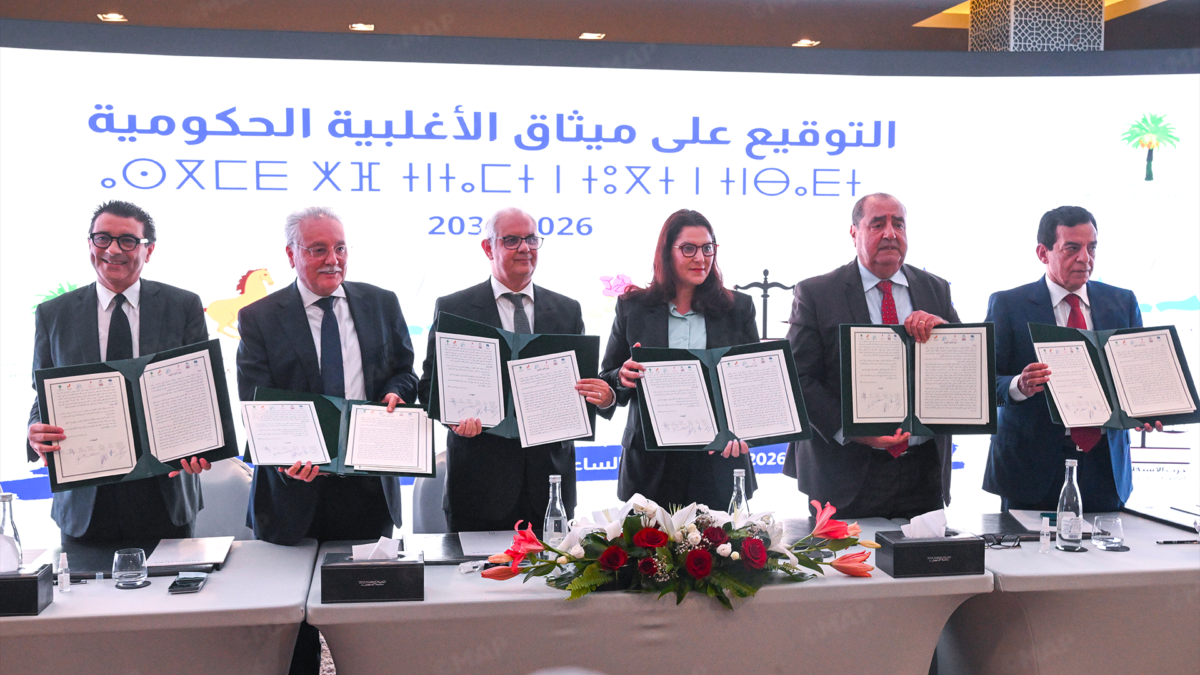
Rabat – The six parties of the governing majority signed the “Majority Charter” in Rabat on Tuesday. This political and moral pact aims to serve as a framework for guiding the actions of the governing coalition and strengthening coordination and cohesion among its members.
Initialed by the leaders of the four parties forming the government—the Authenticity and Modernity Party (PAM), the Istiqlal Party (PI), the Socialist Union of Popular Forces (USFP), and the Party of Progress and Socialism (PPS)—as well as the secretaries-general of the two parties supporting the governing majority: the Constitutional Union (UC) and the Democratic and Social Movement (MDS), this charter aims, in particular, to consolidate the democratic process, strengthen trust in elected institutions and political action, enshrine the principles of good governance, and promote social justice and spatial equity.
It also aims to ensure the implementation of the government program’s commitments, improve the effectiveness of public action, and guarantee concrete results that have a positive impact on the daily lives of citizens.
Among its main objectives, the document sets forth the defense of the Kingdom’s best interests, its sovereignty, and its territorial integrity, particularly regarding the issue of the Moroccan Sahara, as well as the relaunch of reforms in various sectors and the strengthening of the welfare state.
The Charter also emphasizes the preservation of purchasing power, the integration of young people into education, training, and decent employment, the strengthening of strategic sovereignty, and the promotion of a strong economy capable of supporting Morocco’s social and sovereign ambitions.
In an address on this occasion, the Head of Government, Ms. Fatima Ezzahra El Mansouri, coordinator of the PAM’s collective leadership, affirmed that the new government team will ensure the implementation and support of the major projects undertaken in the Kingdom under the leadership of His Majesty King Mohammed VI. She emphasized that the Majority Charter provides a framework for consolidating the cohesion of the majority and ensuring the convergence of actions among its various components in the implementation of the government program.
The governing majority, as a coherent coalition founded on sincerity, trust, and a convergence of visions, will work to translate its commitments into concrete measures capable of improving citizens’ living conditions, preserving their purchasing power, addressing economic and social dysfunctions, and strengthening confidence in political action, she added.
In this context, Ms. El Mansouri stated that the first weeks of the Executive’s term were marked by a positive and fruitful dynamic, characterized by a spirit of commitment, mutual trust, and convergence of decisions among its various components. She believes these factors constitute a solid foundation for the success of the government experience and the strengthening of its efficiency.
For his part, the Secretary General of the Istiqlal Party, Nizar Baraka, indicated that this Charter is intended as a clear roadmap for the governing majority, emphasizing the political dimension of this document, which aims to implement the government program developed based on the political commitments made by the various components of the majority.
For his part, the First Secretary of the USFP, Driss Lachgar, stated that the signing of this Charter reflects the shared commitment of the majority coalition members to strengthen the cohesion of their government action, ensure the convergence of their visions and positions, and consolidate coordination and consultation mechanisms, in order to guarantee the effective and harmonious implementation of the government program.
The Secretary General of the PPS, Nabil Benabdallah, emphasized the efforts that led to the formation of a strong and coherent governing coalition, capable of translating the parties’ commitments into concrete public policies and meeting the expectations and aspirations of citizens.
The Charter provides for the establishment of several coordination and consultation bodies, including a majority leadership body, a joint leadership body for the two Houses of Parliament, and two bodies dedicated respectively to the House of Representatives and the House of Councillors.
Related articles
Maritime Fisheries: Towards a New Social Contract with Sector Stakeholders (Mr. Mezouari)
Rabat – The Minister Delegate for Maritime Fisheries, Ahmed El Mehdi Mezouari, stated on Tuesday before the House…
Moroccan Sahara: Arab countries reiterate their support for the autonomy initiative before the UN General Assembly
United Nations (New York) – Arab countries speaking Monday before the United Nations General Assembly reaffirmed their firm…
UN: Morocco’s Biennial Resolution on Sustainable Tourism Adopted by Consensus
United Nations (New York) – The Second Committee of the United Nations General Assembly adopted on Monday, by…